Sunflower Microgreens: Why They’re a Complete Protein Source
Are sunflower microgreens a complete protein?
Yes. Sunflower microgreens contain all nine essential amino acids the human body cannot make on its own, which is the definition of a complete protein. Most plant foods are incomplete — missing one or more essential amino acids — and need to be combined with other foods to provide full protein coverage. Sunflower microgreens do it on their own.
If you have spent any time in plant-based nutrition, you have heard the warning: most plant proteins are incomplete. You need to combine rice with beans, or lentils with grains, to make sure your body gets the full amino acid picture. It is good advice for most plant foods.
Sunflower microgreens are an exception to it.
The seed that gives us sunflower oil, trail mix, and bird food also happens to carry one of the most complete amino acid profiles in the plant kingdom. And when you grow that seed into a microgreen — a process that takes ten days and a single tray on your kitchen counter — you get that complete protein in a form your body absorbs more efficiently than from the seed itself.
Here is what the research shows, why it matters, and why growing your own makes the whole thing work even better.
What “complete protein” actually means
A complete protein contains all nine essential amino acids: histidine, isoleucine, leucine, lysine, methionine, phenylalanine, threonine, tryptophan, and valine. “Essential” means your body cannot produce them — they have to come from food.
Most animal proteins are complete: meat, fish, eggs, dairy. Most plant proteins are not — they are low or absent in at least one essential amino acid, which is why combining plant proteins has become standard practice in plant-based eating.
A small number of plant foods are the exception. Quinoa is the one most people know. Soy is another. Hemp seeds qualify. And sunflower seeds — and the microgreens grown from them — belong on that list.
For home growers who are also eating plant-based, or who simply want to reduce their reliance on animal protein, this matters. You can grow a complete protein source on your kitchen counter. That is not a small thing.
Why sunflower seeds carry a complete amino acid profile
The sunflower seed evolved to carry everything the new plant needs to survive its earliest days of growth. That means a full reserve of amino acids — not just some of them — packed into a form the seedling can draw on before its roots have found soil nutrients and before its leaves can run photosynthesis.
This is why seeds and legumes tend to be more protein-rich than leaves: they are the plant’s stored food supply, and stored food needs to be nutritionally complete.
What makes sunflower unusual within the seed world is the balance of that profile. While most plant seeds are low in lysine or methionine — the two amino acids most commonly missing from plant proteins — sunflower seeds maintain a meaningful level of both. The resulting amino acid profile is complete across all nine essentials.
Why the microgreen stage beats eating the seed raw
Here is the part that changes the practical calculation: growing the seed into a microgreen makes the protein more accessible, not less.
When you eat raw sunflower seeds, the protein and minerals are partially locked behind a natural compound called phytic acid (also called phytate). Phytic acid binds to minerals in the digestive tract — zinc, iron, magnesium, calcium — and reduces how much your body can absorb. It is the main reason nutritionists often recommend soaking, sprouting, or roasting seeds before eating them.
During germination and early microgreen growth, phytic acid levels drop significantly as the plant uses those bound minerals to power its own development. By the time you harvest a sunflower microgreen at around day eight to twelve, the antinutrient load is substantially lower than in the raw seed.
The practical result: research confirms that minerals like magnesium and zinc are more bioavailable from sunflower microgreens than from the equivalent raw seed. You get more of what you eat.
A 2023 study published in Frontiers in Plant Science found that sunflower microgreens had a lower phytic acid-to-zinc ratio than raw seeds, indicating higher bioaccessibility of zinc from the microgreen form. A 2025 study in Scientific Reports recorded magnesium content in sunflower microgreens ranging from 45 to 86 mg per 100g fresh weight depending on growing conditions — a meaningful contribution to daily intake.
The full nutrition profile
Complete protein is the headline, but sunflower microgreens are nutritionally dense across the board.
| Nutrient | What sunflower microgreens provide | Notes |
|---|---|---|
| Protein | Complete — all 9 essential amino acids | ~2g per 64g serving; bioavailability higher than raw seed |
| Vitamin A (beta-carotene) | Good source | Supports eye health, immune function |
| B vitamins | B1, B2, B3, B5, B6, folate | Energy metabolism; folate particularly significant |
| Vitamin C | Present | Antioxidant; supports iron absorption |
| Vitamin E | Present | Antioxidant; supports skin and immune health |
| Vitamin K | Present | Blood clotting, bone metabolism |
| Calcium | Highest among tested microgreen varieties in some studies | Bone health; notable for a plant food |
| Magnesium | 45–86 mg/100g fresh weight | Muscle function, sleep, energy production |
| Zinc | Good source; higher bioaccessibility than raw seed | Immune function, wound healing |
| Iron | Present | Red blood cell production |
| Potassium | Present | Heart and muscle function |
| Healthy fats | Predominantly polyunsaturated and monounsaturated | Retained from the seed; beneficial for cardiovascular health |
Sources: Scientific Reports (2025); Frontiers in Plant Science (2023); ISU Microgreen Nutritional Profile; BetterMe Sunflower Microgreens Nutrition.
A few things on this list are worth highlighting individually.
Folate. B vitamins as a group are well represented in sunflower microgreens, but folate stands out. It is essential for cell division and DNA synthesis — particularly important during pregnancy and for anyone with elevated homocysteine levels. Plant-based eaters often watch their folate intake carefully; sunflower microgreens are a good addition to that picture.
Calcium. One study found sunflower microgreens had the highest calcium content among all the microgreen varieties tested. This is unusual — calcium is not a nutrient most people associate with microgreens, let alone one from a seed rather than a leafy green. It does not replace dairy or fortified foods as a calcium source, but it is a meaningful contribution from a crop you can grow at home.
The fat profile. Sunflower seeds are known for their healthy fat content, and that carries through to the microgreen stage. The fats in sunflower microgreens are predominantly polyunsaturated and monounsaturated — the kinds associated with cardiovascular benefit — rather than saturated.
What they taste like and how to eat them
This matters. A food that is nutritionally impressive but unpleasant to eat does not actually get eaten.
Sunflower microgreens are, by most accounts, one of the most enjoyable microgreens to eat. They have a nutty, slightly rich flavour that is unlike the sharp or peppery notes of broccoli or radish microgreens. The texture is substantial — more like a small leaf with a bit of crunch than the delicate wisp of alfalfa or clover sprouts.
They work raw, and they hold up well. A handful in a sandwich or wrap, scattered over a grain bowl, stirred into a salad, laid on top of avocado toast, or piled next to eggs — they improve the dish without overwhelming it.
Because heat significantly degrades vitamins C and E, and reduces the activity of beneficial enzymes, eating them raw preserves the most nutritional value. Unlike cooking greens, where wilting concentrates nutrients, heating microgreens primarily loses them.
Practical serving ideas:
- Handful on top of scrambled eggs or an omelette
- Layered into a sandwich or burger in place of lettuce
- Mixed into a grain bowl (quinoa, farro, rice) for a protein stack
- Added to a smoothie — the nutty flavour works well with banana, almond butter, and oat milk
- Used as a topping for hummus or avocado toast
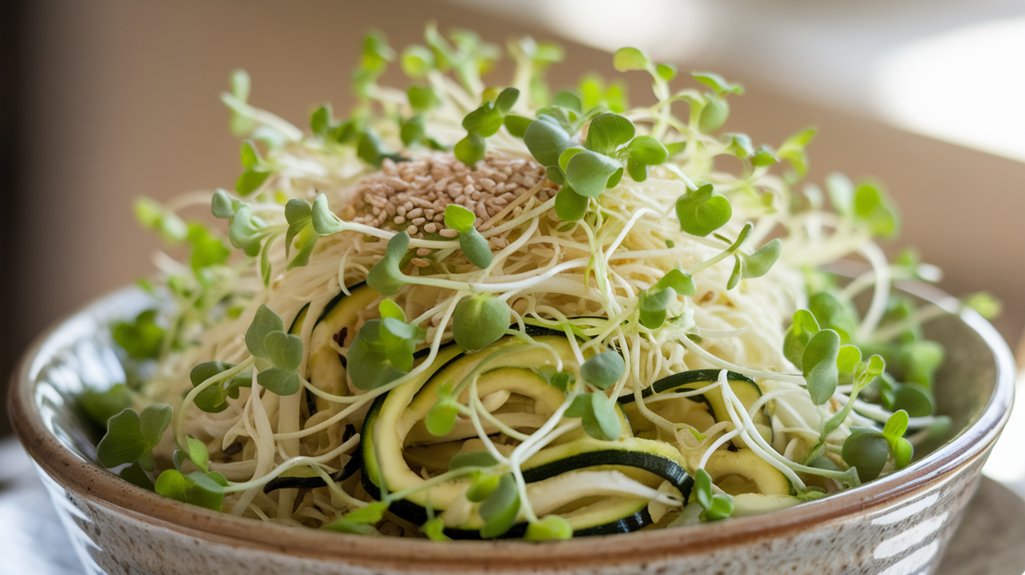
- Stirred into a cold noodle salad at the end
One serving is typically a small handful — around 30 to 60 grams. At 64g, you get roughly 2g of complete protein alongside the full vitamin and mineral package above.
How much and how often
There is no single “recommended dose” for sunflower microgreens. What the nutritional data suggests is that they are dense enough to contribute meaningfully at quantities you can realistically eat — a handful most days rather than large medicinal amounts.
The most useful framing: sunflower microgreens make a good daily addition to whatever you are already eating, not a standalone meal. A handful at lunch and another at dinner gives you around 4g of complete plant protein, a useful contribution of magnesium, calcium, zinc, folate, and fat-soluble vitamins — all without tracking a single macro.
For plant-based eaters, the complete protein angle makes them worth prioritising over some other microgreen varieties when tray space is limited.
The home-growing advantage: freshness and cost
This is where the calculation shifts in a way supermarket buyers cannot access.
Commercial sunflower microgreens — if you can find them, which is not always guaranteed — are expensive. A small punnet costs several times what an equivalent weight of salad leaves costs, and by the time it reaches you, it may be several days past harvest. Vitamins C and E begin degrading immediately after cutting; folate follows. The nutritional content you read about is not exactly what you are eating.
When you grow your own sunflower microgreens and harvest them the morning you eat them, you are eating at peak nutrition. Zero transit time. Zero shelf degradation. The vitamins are where they were when the plant was alive.
The cost per batch is also genuinely low. A packet of sunflower microgreen seeds — enough for multiple trays — costs a few dollars. One standard 10×20 tray, grown over ten to twelve days, yields several generous servings. Per gram of complete protein eaten fresh, it is hard to find a cheaper source.
Growing sunflower microgreens at home: what you need to know
Sunflower microgreens are one of the more satisfying varieties to grow because the seeds are large, the germination is reliable, and the harvest is substantial. They are moderately straightforward — slightly more involved than radish or broccoli because the large seeds need soaking first and a heavier blackout weight to press them flat, but well within reach for any beginner who has grown one batch before.
Key growing notes:
| Step | What to do |
|---|---|
| Seed soak | Soak sunflower seeds for 8–12 hours before planting — the hard outer shell needs softening |
| Growing medium | Soil or coco coir mat both work; sunflower roots are strong and benefit from a deeper medium |
| Seeding | Spread seeds in a single dense layer — they expand significantly during germination |
| Blackout | Cover with a heavy flat tray (weighted down) for days 1–4; this presses the roots down and develops strong stems |
| Watering | Bottom water — add water to the base tray, not directly onto seeds, to keep the canopy dry and reduce mould risk |
| Light | Move to bright indirect light after removing the dome, around day 4–5 |
| Harvest | Days 8–12, when the first true leaves have just opened and the stems are standing tall |
| Seed hulls | Some hulls cling to the leaves after the dome is removed; misting lightly and giving the tray a gentle shake usually clears them. A second rinse at harvest removes stragglers |
For the full growing method, the guide to growing sunflower microgreens on this site covers every stage in detail.
One of the best trays you can grow
Most microgreens are nutritionally impressive in at least one dimension. Sunflower microgreens are impressive across several at the same time — complete protein, bioavailable minerals, fat-soluble vitamins, and a taste that does not require you to disguise them.
For anyone growing at home who wants maximum nutritional return from a single tray, sunflower is the answer most of the time.
⟶ Ready to grow your first tray? The guide to growing sunflower microgreens covers sowing to harvest in full.
⟶ Want to understand how sunflower microgreens fit into the broader nutrition picture? See microgreens vs. spinach and kale for an honest comparison of what each brings to the table.
⟶ Not sure where to source your seeds? The seed library has notes on sunflower varieties recommended for microgreen growing.