
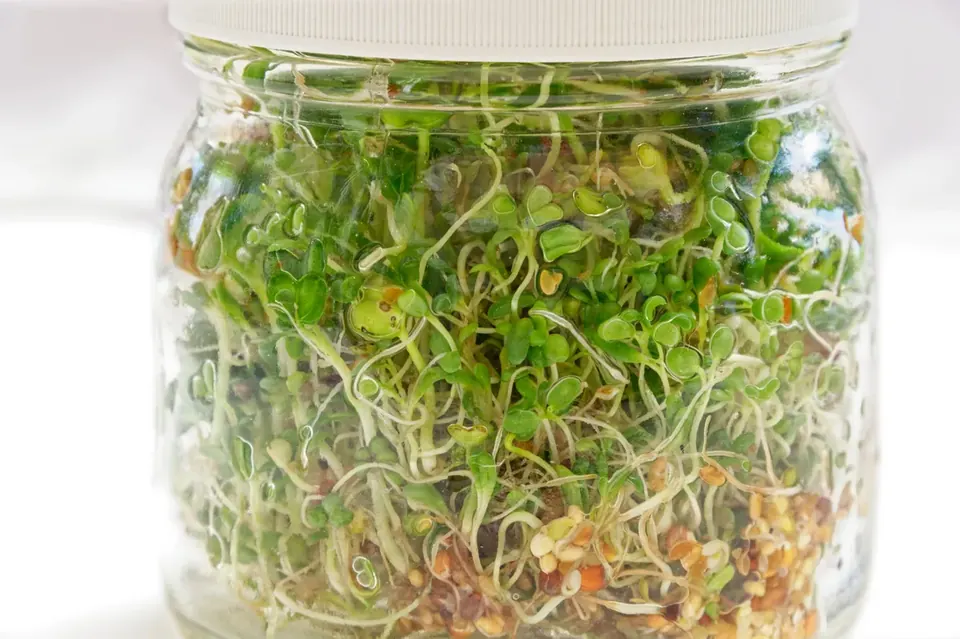
What are sprouts?
A sprout is a seed in its first few days of growth. Once you soak a seed in water, it wakes up. A small root pushes out of the hull, then a pale stem, and for many seeds two small seed leaves. You eat it at that stage, usually 2 to 6 days after the soak, before it grows true leaves.
Sprouts need no soil and no light. Everything they need is already packed inside the seed, so all you add is water and air. That makes them the fastest food you can grow at home, and the only one that's ready the same week you start it.
The word gets used for a few different things, so here's how they compare:
| Grown in | Ready in | You eat | |
|---|---|---|---|
| Sprouts | A jar, tray or bag. Water only | 2–6 days | The whole thing: seed, root, stem |
| Shoots (pea, sunflower) | A tray, often on soil | 8–12 days | The stem and leaves, cut above the root |
| Microgreens | A tray on soil or a mat, with light | 7–21 days | The stem and leaves, cut above the root |
| Brussels sprouts | A garden, for months | 3–4 months | A mature vegetable, not a seed sprout |
If you're trying to decide between the first and third, read microgreens vs sprouts.
Types of sprouts
Most sprouting seeds fall into four groups. Each one behaves a little differently in the jar.
Beans and legumes
Mung beans, lentils, chickpeas, peas and adzuki beans. These are the big, crunchy sprouts. They soak overnight (6 to 12 hours) and are ready in 2 to 4 days, often with just a short tail. Most people cook them, and they're the easiest place to start.
Small salad seeds
Alfalfa, broccoli, radish, clover, mustard and fenugreek. These grow into the thin, leafy sprouts you see on sandwiches. They need a shorter soak, from 1 to 8 hours depending on the seed, and take 4 to 6 days. Flavours run from mild and grassy (alfalfa, clover) to hot (radish, mustard).
Grains and pseudo-grains
Wheat, oats, barley, rye, quinoa and buckwheat. Grains are usually eaten as short sprouts after 1 to 3 days, or dried and ground into sprouted flour. Grown longer in a tray, wheat becomes wheatgrass.
Gel-forming seeds
Chia, basil, cress and flax. These seeds form a sticky gel the moment they touch water, so they clump and rot in a jar. Instead, you mist them on a plate, a tray or a clay sprouter. Don't soak them.
Browse all 67 seeds, with soak times and harvest days, in the Seed Library or the sprouting calendar.
How sprouting works
Every seed follows the same four steps. Only the times change.
- Soak. Cover the seed with cool water. Small seeds need 1 to 8 hours and beans 6 to 12. Gel-forming seeds skip this step.
- Drain. Pour the water off and let the jar rest upside down at an angle so air can flow.
- Rinse twice a day. Fill the jar and swirl it, then drain it again, morning and evening. Sprouts need to stay damp, never wet.
- Harvest and dry. When they reach the size you like, give them a final rinse. Let them dry for a few hours, then refrigerate.
That's the whole job, about two minutes a day. The step-by-step guide covers each step in detail, and our sprouting calculator gives you the exact soak time and harvest date for any seed.
Why grow your own sprouts?
- Cost. A tablespoon of small seed grows about a cup of sprouts, so each batch costs a small part of a store clamshell.
- Freshness. You eat them the day they're ready, not after days in a truck and on a shelf.
- Choice. Shops carry two or three kinds at most. At home you can grow fenugreek, red clover, lentils or a spicy radish mix.
- Year-round. Sprouts don't care about the season or the weather outside. A kitchen counter in January works as well as one in July.
Are sprouts good for you?
Sprouts are low in calories and add fresh greens to a meal without any cooking. Some have specific claims to fame. Young broccoli sprouts, for example, hold 10 to 100 times more glucoraphanin than mature broccoli.1
Sprouting can also lower phytate in grains and beans. Phytate is a natural compound that holds onto minerals like iron and zinc. A 2022 review found that sprouting can reduce it and may make some nutrients easier for your body to use, though results vary a lot by seed and method.2
For the numbers, see sprouts benefits and nutrition.
Are sprouts safe to eat?
Food safety: the warm, damp conditions that sprout seeds also suit bacteria such as Salmonella, Listeria and E. coli. The FDA says young children, pregnant people, older adults and anyone with a weakened immune system should not eat raw or lightly cooked sprouts of any kind.3 Health Canada advises everyone to cook sprouts well before eating them.4
Growing your own doesn't remove the risk, but you control the steps that lower it. Buy seed sold for sprouting, wash your jar before each batch, drain completely every time, and refrigerate once they're dry. Cooking sprouts, even briefly in a stir-fry or soup, is the safest way to eat them. Read the full sprout safety guide.
Every sprouting guide on this site
New to sprouting?
Follow the step-by-step guide. It walks you through your first jar day by day, with soak times for every common seed.