
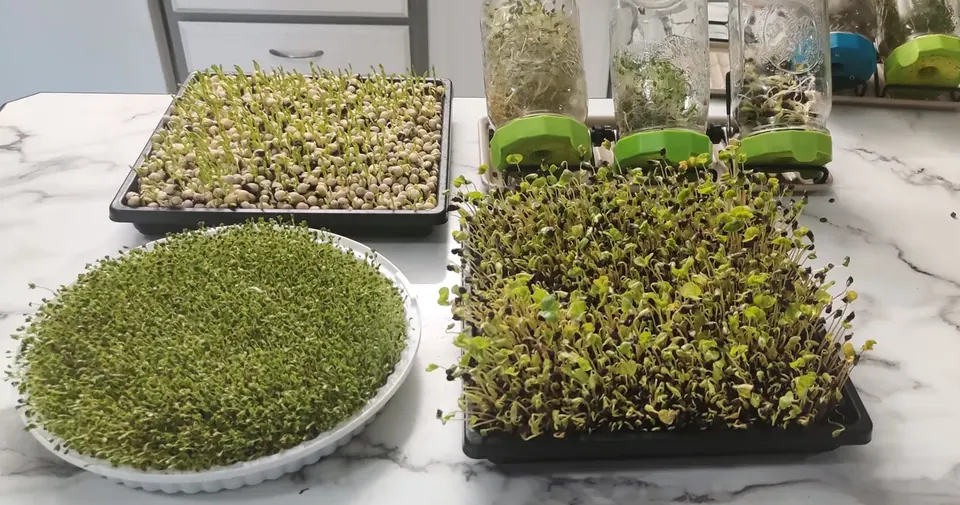
Short answer: the questions we hear most are about getting started, soak times, mold, safety and storage. For a quick start, grow mung beans or alfalfa in a jar and rinse twice a day. Fuzzy white roots are usually root hairs, not mold. Cook sprouts if you're in a higher-risk group, and store everything dry and cold.
About this sprouts and microgreens FAQ
The answers here are short summaries. Each links to the full guide. Growing data comes from Sprouting.com's product pages and safety advice from the FDA and Health Canada.123
Can't find your question? Browse the seed library or the glossary, or contact us.
More help beyond the sprouts and microgreens FAQ
Getting started
What's the difference between sprouts and microgreens?
Sprouts grow in water and you eat the whole thing in 2 to 5 days. Microgreens grow on soil or a mat with light and are cut above the roots in 7 to 21 days. Read microgreens vs sprouts.
What do I need to start sprouting?
A wide-mouth jar, a mesh sprouting lid, a bowl to drain it upside down, and seed sold for sprouting. See start here.
What are the easiest seeds to start with?
Mung beans, lentils and alfalfa for sprouts. Radish, broccoli and pea shoots for microgreens. See easiest microgreens.
Can I use seeds from the grocery store or garden centre?
It's best not to. Garden seed may be treated with fungicide, and grocery seed may be old or not handled for sprouting. Use seed sold for sprouting.
Growing
How long should I soak seeds?
It depends on the seed: 1 to 2 hours for broccoli, 4 to 12 for alfalfa, 6 to 12 for beans. Gel seeds like chia aren't soaked. See the soak time chart.
How often should I rinse sprouts?
Twice a day, morning and evening. In hot weather, three times. Drain completely each time.
Do microgreens need a grow light?
Not always. A bright south-facing window can work in summer. In winter or a dim room, a simple LED shop light helps a lot. See microgreens grow light.
How much seed do I need for a microgreen tray?
About 10 to 25 g for small seeds and 150 to 275 g for peas and sunflower per 10 × 20 inch tray. See the seeding chart.
Problems
Is the white fuzz on my sprouts mold?
Usually not. Fine white root hairs appear on day 2 or 3 and vanish when rinsed. Mold is patchy, often gray or coloured, and smells musty. See mold vs root hairs.
Why are my sprouts slimy or smelly?
Too much water and not enough air. Drain better, use less seed and keep the jar cool. Throw out slimy batches. See sprouting problems.
Why are my microgreens falling over?
Usually too little light, or damping off from wet soil. Give more light and water from below. See microgreen mistakes.
Safety and storage
Are raw sprouts safe to eat?
Raw sprouts carry a higher food-safety risk. The FDA says higher-risk groups should not eat them raw or lightly cooked, and Health Canada advises everyone to cook sprouts. See are sprouts safe to eat?
How long do sprouts and microgreens last?
Leafy sprouts keep 5 to 7 days and bean sprouts 3 to 5 if dried well. Most microgreens keep 5 to 10 days. See how to store sprouts and how to store microgreens.
Can I freeze sprouts or microgreens?
Only for cooking, smoothies or pesto. Freezing makes them limp.
Nutrition
Are microgreens more nutritious than vegetables?
Per gram, many microgreens have higher concentrations of some vitamins than mature leaves, but portions are small. See the microgreens nutrition chart.
Why are broccoli sprouts so popular?
They're a well-known source of glucoraphanin, which becomes sulforaphane when you chew them. See broccoli sprouts benefits.
Buying seeds
Where do you recommend buying seeds?
We link to Sprouting.com, a long-running sprouting seed company, and earn a commission on sales. See our affiliate disclosure.
Should I buy organic seed?
It's a good choice if organic matters to you, but seed sold for sprouting, freshness and clean growing matter most. See organic sprouts.