
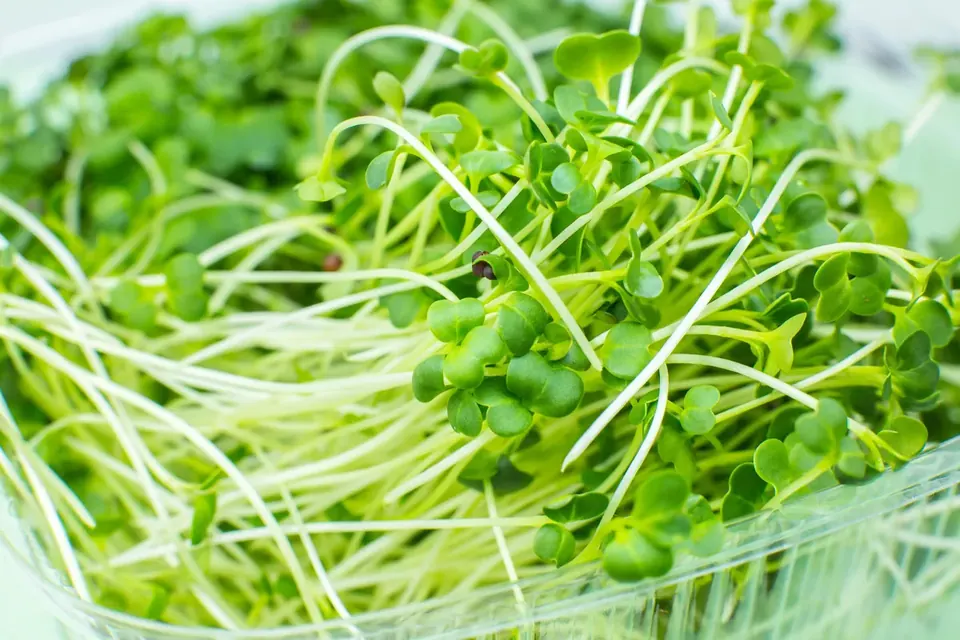
Short answer: in a 2012 study of 25 microgreens, red cabbage was highest in vitamin C (147 mg per 100 g), garnet amaranth in vitamin K1 (4.1 µg per g), green daikon radish in vitamin E (87.4 mg per 100 g), and red sorrel and cilantro in beta-carotene (12.1 and 11.7 mg per 100 g).1 Most microgreens had higher concentrations than mature leaves.
About the microgreens nutrition chart study
Xiao and colleagues tested 25 microgreens bought from growers.1 They measured vitamins C, K1 and E and carotenoids. Numbers below are per fresh weight and come from the paper's text. Light, growing method and harvest age all change nutrient levels, so home-grown greens will differ.
Vitamin C in microgreens
| Microgreen | Vitamin C (mg per 100 g) |
|---|---|
| Red cabbage | 147.0 |
| Garnet amaranth (red amaranth) | 131.6 |
| China rose radish | 95.8 |
| Opal basil | 90.8 |
| Opal radish | 90.1 |
| Golden pea tendrils | 25.1 |
| Sorrel | 20.4 |
| Mature broccoli, for comparison | 89.2 |
| Mature red cabbage | 57.0 |
| Mature spinach | 28.1 |
Vitamin K1 in microgreens
| Microgreen | Vitamin K1 (µg per g) |
|---|---|
| Garnet amaranth | 4.1 |
| Red sorrel | 3.3 |
| Green basil | 3.2 |
| Pea tendrils (peas) | 3.1 |
| Red cabbage | 2.8 |
| Popcorn shoots, golden pea tendrils | 0.6 to 0.9 |
The study lists mature amaranth, basil and red cabbage at 1.14, 0.41 and 0.04 µg per g. That's far lower than their microgreens.
Vitamin E in microgreens
| Microgreen | Alpha-tocopherol (mg per 100 g) |
|---|---|
| Green daikon radish | 87.4 |
| Cilantro, opal radish, peppercress | 41.2 to 53.1 |
| Golden pea tendrils | 4.9 |
Carotenoids in microgreens
| Microgreen | Beta-carotene (mg per 100 g) | Lutein + zeaxanthin (mg per 100 g) |
|---|---|---|
| Red sorrel | 12.1 | 8.8 |
| Cilantro | 11.7 | 10.1 |
| Red cabbage | 11.5 | 8.6 |
| Peppercress (cress) | 11.1 | |
| Garnet amaranth | 8.4 | |
| Popcorn shoots | about 0.6 | 1.3 |
| Mature spinach, for comparison | 7.2 |
Popcorn shoots and golden pea tendrils grow without light, so they're low in carotenoids. Light builds these pigments.
What this microgreens nutrition chart means for you
- Concentrated, not magic. Microgreens pack a lot into small leaves, but you eat less by weight than a bowl of spinach.
- Variety wins. Different microgreens lead in different nutrients.
- Light matters. Green and red microgreens grown in good light build more vitamins and pigments.
- Freshness matters. Some vitamins, like vitamin C, fade in storage.
Read microgreens vs mature greens and health benefits of microgreens for more context. For sprout nutrition, see nutritional value of sprouts.
Frequently asked questions
Which microgreen is the most nutritious?
No single microgreen led in everything. In the 2012 study, red cabbage was highest in vitamin C, garnet amaranth in vitamin K1, green daikon radish in vitamin E, and red sorrel and cilantro in carotenoids.
Are microgreens more nutritious than mature greens?
Per gram, the study found microgreens generally had higher concentrations of these vitamins than mature leaves in the USDA database. But portions of microgreens are small.
Why aren't all microgreens in the chart?
We only list figures published in the study's text. The study tested 25 commercial microgreens, and some crops in our seed library weren't included.
Sources
- Xiao Z, Lester GE, Luo Y, Wang Q. Assessment of vitamin and carotenoid concentrations of emerging food products: edible microgreens. Journal of Agricultural and Food Chemistry, 2012. Link