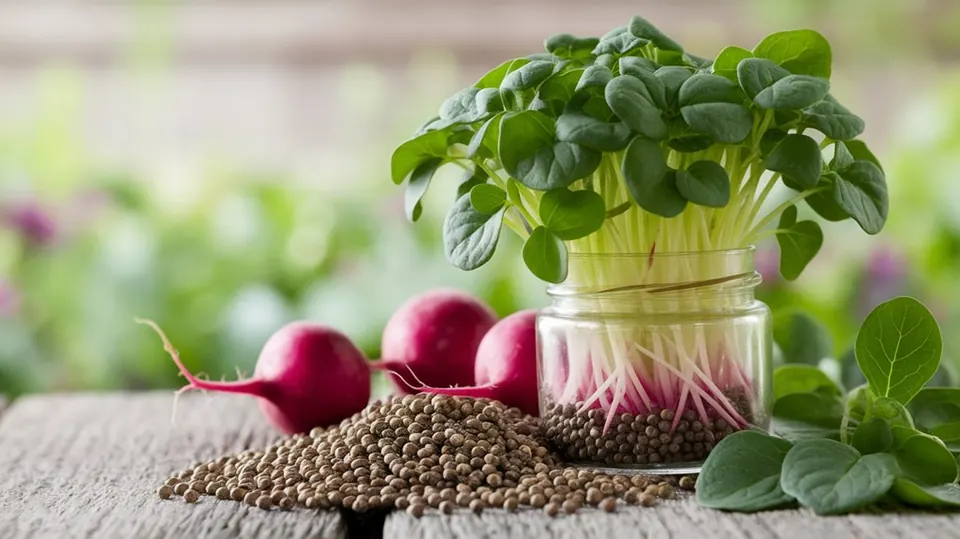
Short answer: soak 1 tablespoon of daikon radish seed for 4 to 6 hours. Drain it into a jar, rinse and drain twice a day, and keep it out of direct sun. Harvest in 4 to 5 days, when the leaves open. For microgreens, sow 25 to 35 g on a 10 × 20 inch tray and cut at 8 to 10 days.
What are daikon radish sprouts?
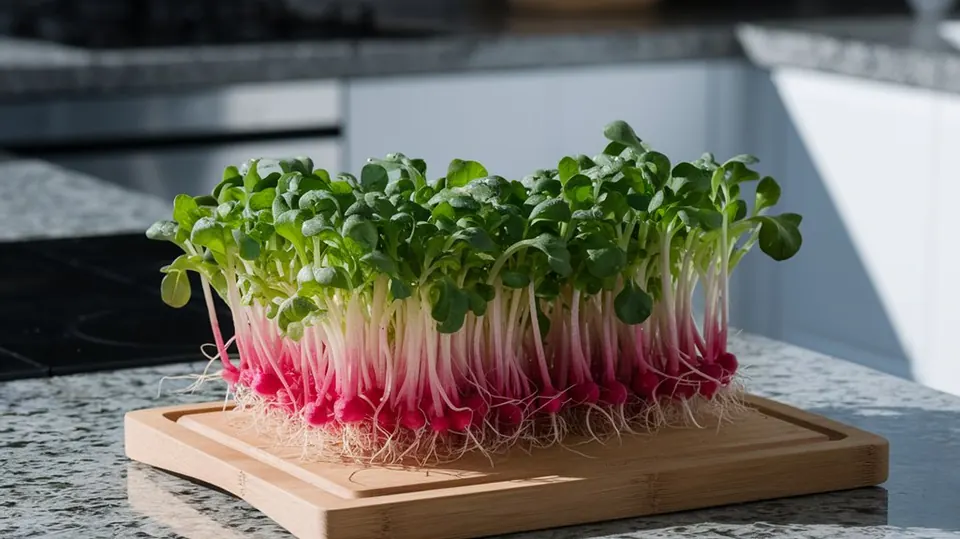
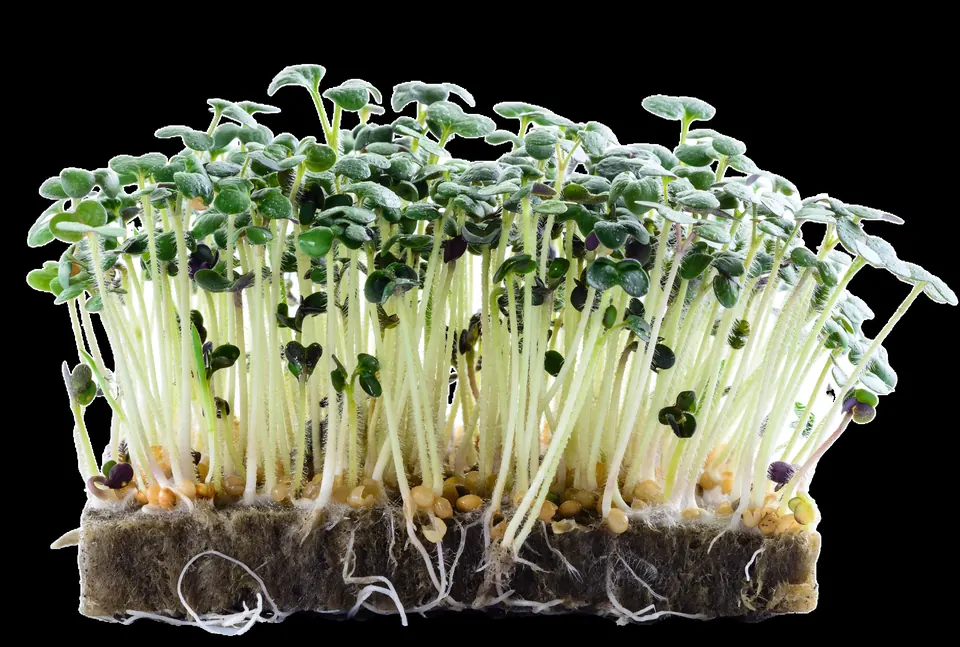
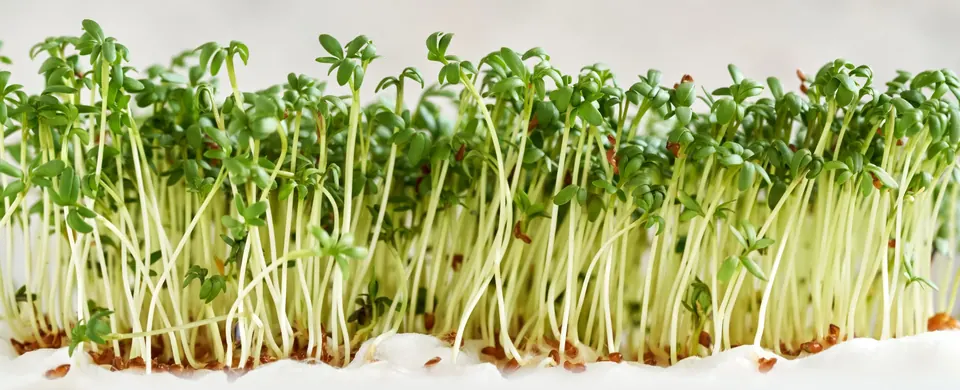
Daikon (Raphanus sativus var. longipinnatus) is the long white radish used across East Asian cooking. Its sprouts have white stems, green leaves and a hot, clean radish bite. In Japanese cooking, daikon sprouts are called kaiware and are used on salads, sushi and noodles.
Daikon seed grows fast and evenly. It works in a jar as sprouts or on soil as microgreens. For other radish types, see the main radish seed guide.
How to grow daikon radish sprouts
- Day0
Soak
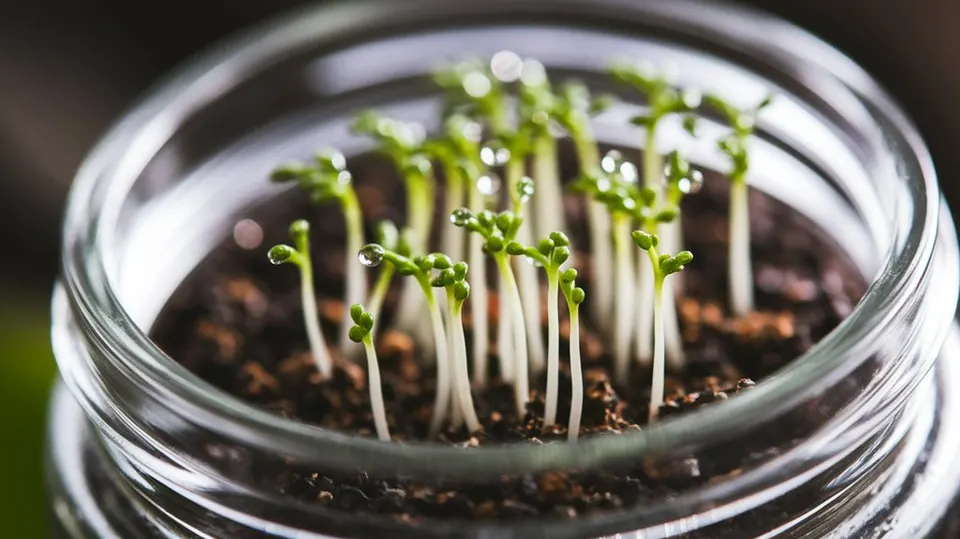
Put 1 tablespoon of seed in a quart jar with a mesh lid. Rinse, then soak in cool water for 4 to 6 hours.
- Day0–4
Rinse and drain
Drain well and rest the jar upside down at an angle. Rinse and drain twice a day, morning and evening.
- Day3–4
Green them up
Once small leaves appear, move the jar near a bright window, out of direct sun, for a few hours.
- Day4–5
Harvest
Give a final rinse, drain well and let them dry for a few hours before refrigerating.
Fuzzy white root hairs on day 2 or 3 are normal. Rinse them: they flatten and disappear when wet. Read mold on sprouts vs root hairs.
How to grow daikon radish microgreens
Sow 25 to 35 g of seed on a 10 × 20 inch tray of moist potting mix, mist it and cover it. Keep it dark for 2 to 3 days, then uncover and give bright light. Water from below and cut above the soil at 8 to 10 days. The full method is in radish microgreens.
In a USDA-led study of 25 microgreens, green daikon radish had the highest vitamin E (alpha-tocopherol) of any crop tested.1
Daikon radish sprouts: problems and fixes
| Problem | Likely cause | Fix |
|---|---|---|
| Sour smell or slime | Poor drainage, too much seed | Use 1 tbsp per quart jar, drain fully |
| Patchy sprouting | Old seed or uneven soak | Use fresh seed, soak 4–6 hours |
| Pale yellow leaves | No light at the end | Give a few hours of indirect light on day 4 |
| Very hot taste | Grown too long | Harvest at 4 days |
Storing daikon sprouts
Dry the sprouts well, then store them in a lined container in the fridge. They keep about 5 to 7 days. See how to store sprouts.
How to eat daikon radish sprouts
- On sushi, poke and rice bowls
- In miso soup or noodle soups, added at the end
- On sandwiches, tacos and avocado toast
- In salads, mixed with milder sprouts
Try radish sprout bruschetta or radish sprout and cucumber salad.
Safety
Raw sprouts can carry bacteria. The FDA says higher-risk groups should not eat raw or lightly cooked sprouts, and Health Canada advises everyone to cook them.23 Microgreens are a lower-risk way to eat daikon raw.
Daikon radish FAQ
How long do daikon radish sprouts take to grow?
About 4 to 5 days in a jar. Soak the seed for 4 to 6 hours, then rinse and drain twice a day until the small leaves open and turn green.
Are daikon sprouts the same as kaiware?
Yes. Kaiware is the Japanese name for daikon radish sprouts, often grown a little taller with light so the leaves turn bright green.
What do daikon radish sprouts taste like?
Hot and peppery, like fresh radish, with a juicy, crisp stem. They're spicier than alfalfa or broccoli sprouts.
Are daikon microgreens nutritious?
In a USDA-led study of 25 microgreens, green daikon radish had the highest vitamin E of all the crops tested.

Written by Michael
A passionate sprouting professional sharing practical tips for growing sprouts and microgreens at home. More about Michael
Sources
- Xiao Z, Lester GE, Luo Y, Wang Q. Assessment of vitamin and carotenoid concentrations of emerging food products: edible microgreens. Journal of Agricultural and Food Chemistry, 2012. Link
- U.S. Food and Drug Administration. Selecting and Serving Produce Safely. Link
- Health Canada. Food safety tips for sprouts. Link