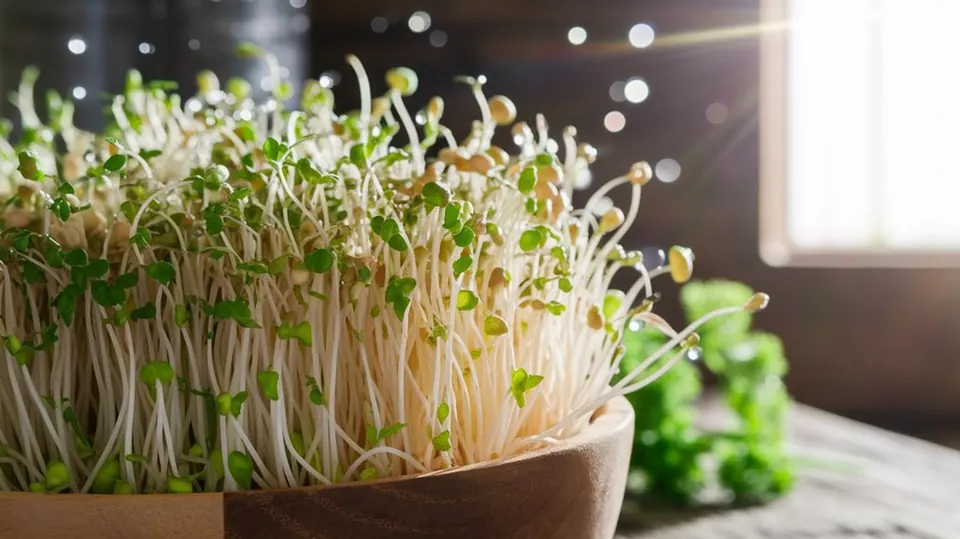
Short answer: sprouts are a fresh, low-calorie vegetable. Leafy sprouts like alfalfa have about 23 calories per 100 g. Lentil and pea sprouts have over 100 calories, with 9 g of protein and plenty of folate and iron. Sprouting can lower phytate, which may help your body absorb minerals. The biggest caution is food safety, so cook sprouts if you're in a higher-risk group.
Sprouts nutrition compared
Here's what USDA FoodData Central lists for 100 g of common raw sprouts.1
| Per 100 g raw | Alfalfa | Mung bean | Radish | Lentil | Pea | Soybean |
|---|---|---|---|---|---|---|
| Calories | 23 | 30 | 43 | 106 | 124 | 122 |
| Protein (g) | 4.0 | 3.0 | 3.8 | 9.0 | 8.8 | 13.1 |
| Carbohydrates (g) | 2.1 | 5.9 | 3.6 | 22.1 | 27.1 | 9.6 |
| Vitamin C (mg) | 8.2 | 13.2 | 28.9 | 16.5 | 10.4 | 15.3 |
| Folate (µg) | 36 | 61 | 95 | 100 | 144 | 172 |
| Iron (mg) | 1.0 | 0.9 | 0.9 | 3.2 | 2.3 | 2.1 |
| Potassium (mg) | 79 | 149 | 86 | 322 | 381 | 484 |
Two groups stand out:
- Leafy sprouts (alfalfa, radish, clover, broccoli) are light and watery, with few calories. Radish is much higher in vitamin C.
- Bean and pea sprouts (lentil, pea, soybean) are much more filling, with three to four times the protein and far more folate and iron.
Mung bean sprouts sit in between: watery and light, like leafy sprouts, but with more folate.
Sprouts benefits: what sprouting does to a seed
When a seed sprouts, it starts using its stored food to grow. That changes it in a few useful ways:
- Less phytate. Phytate is a natural compound in seeds, grains and beans that holds onto minerals like iron and zinc. A 2022 review found that sprouting can reduce phytate and may make some nutrients easier to absorb, though results vary a lot by seed and method.2
- More of some vitamins. Vitamin C, which dry seeds barely have, appears as the sprout grows.
- Softer, easier to cook. Sprouted beans and grains cook faster than dry ones.
- Special compounds in some sprouts. Young broccoli sprouts hold 10 to 100 times more glucoraphanin than mature broccoli.3
Sprouts benefits backed by research
- Eating more vegetables. The simplest and best-supported benefit. Sprouts are fresh, crunchy and easy to add to almost any meal.
- Filling plant protein. Lentil, pea and soybean sprouts add protein and fiber that help you feel full.
- Digestion (broccoli sprouts). In a 4-week study, 48 people with mild constipation who ate 20 g of broccoli sprouts a day improved their bowel-habit scores; people eating alfalfa sprouts didn't.4 Read more in broccoli sprouts benefits.
Sprouts benefits that aren't proven
You'll see claims that sprouts "boost immunity," "detox the body," are "full of living enzymes" or "cure" health problems. There's no good human evidence for those claims. Sprouts are a good food, not a medicine.
Enzymes in raw food, for example, are mostly broken down in your stomach like any other protein. The real benefits are the nutrients and the fact that sprouts help you eat more plants.
Who should be careful with sprouts?
A few other cautions:
- Alfalfa and lupus: alfalfa contains L-canavanine, linked to lupus-like illness. People with lupus should avoid alfalfa.7
- Kidney-type beans: raw kidney bean sprouts contain a natural toxin. Always cook them thoroughly.8
- Blood thinners: leafy sprouts contain some vitamin K. Keep your intake steady and talk to your doctor if you take warfarin.
Read the full sprout safety guide.
How to get the most from sprouts
- Eat a variety. Mix leafy sprouts with bean and lentil sprouts.
- Eat them fresh. Home-grown sprouts can go from jar to plate the same day.
- Cook them lightly. A quick stir-fry or steam keeps the crunch and makes them safer.
- Grow your own. It's cheap and fast. Start with our step-by-step sprouting guide.
For a comparison with microgreens, see microgreens vs sprouts.
Frequently asked questions
Are sprouts healthy?
Yes. Sprouts are a fresh vegetable that adds vitamins, minerals and fiber for few calories. Bean and lentil sprouts are more filling, with more protein and iron. The main health caution is food safety: raw sprouts can carry bacteria, so cooking them is safer.
Which sprout is the most nutritious?
It depends on what you want. Lentil, pea and soybean sprouts have the most protein and iron per 100 g. Radish sprouts have more vitamin C than most. Broccoli sprouts are famous for glucoraphanin. A mix gives you the most.
Do sprouts have more nutrients than seeds?
Sprouting changes a seed. Some vitamins, like vitamin C, rise as the sprout grows, and phytate, which binds minerals, can fall. Because sprouts take up water, nutrients per 100 g are lower than in dry seed, but they're easier to eat in larger amounts.
Are raw sprouts more nutritious than cooked?
Raw sprouts keep more vitamin C, which heat breaks down. But cooking lowers the food-poisoning risk, which matters more for many people. A quick stir-fry or steam is a good balance.
How many sprouts should I eat?
There's no set amount. A handful or two a day is a reasonable way to add them to meals. Treat them as one of your vegetables rather than a supplement.

Written by Michael
A passionate sprouting professional sharing practical tips for growing sprouts and microgreens at home. More about Michael
Sources
- U.S. Department of Agriculture, Agricultural Research Service. FoodData Central (SR Legacy and Foundation Foods), values per 100 g. Link
- Elliott H, Woods P, Green BD, Nugent AP. Can sprouting reduce phytate and improve the nutritional composition and nutrient bioaccessibility in cereals and legumes? Nutrition Bulletin, 2022. Link
- Fahey JW, Zhang Y, Talalay P. Broccoli sprouts: an exceptionally rich source of inducers of enzymes that protect against chemical carcinogens. PNAS, 1997. Link
- Yanaka A. Daily intake of broccoli sprouts normalizes bowel habits in human healthy subjects. Journal of Clinical Biochemistry and Nutrition, 2018. Link
- U.S. Food and Drug Administration. Selecting and Serving Produce Safely. Link
- Health Canada. Food safety tips for sprouts. Link
- Alcocer-Varela J, et al. Effects of L-canavanine on T cells may explain the induction of systemic lupus erythematosus by alfalfa. Arthritis & Rheumatism, 1985. Link
- Rodhouse JC, et al. Red kidney bean poisoning in the UK: an analysis of 50 suspected incidents between 1976 and 1989. Epidemiology and Infection, 1990. Link