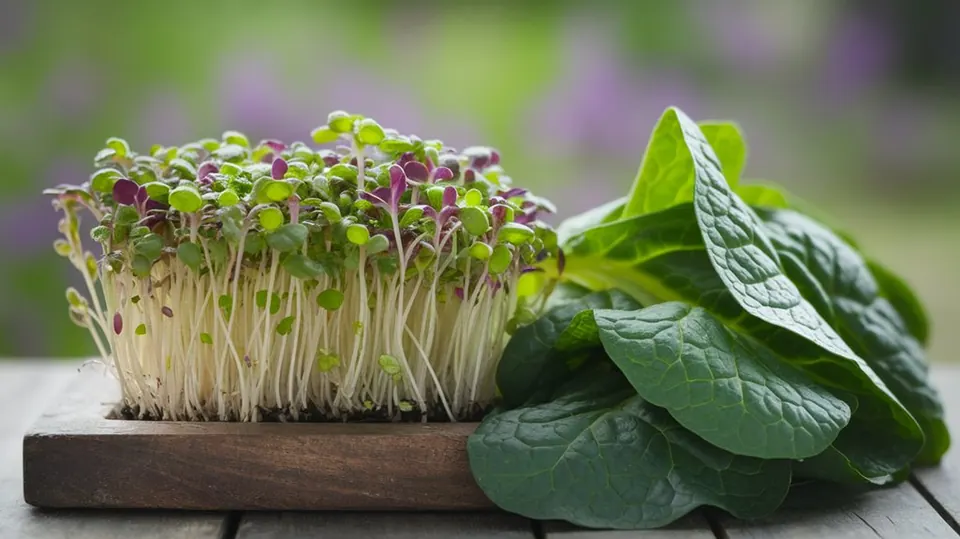
Short answer: in a study of 25 microgreens, the small leaves had more vitamins C, E and K per gram than grown leaves.1 Red cabbage microgreens had up to 147 mg of vitamin C per 100 g. Raw red cabbage has 57 mg.2 But results vary by crop, and portions are small. Eat both.
What the study found
In 2012, a research team tested 25 microgreens bought from growers.1 Here's what they found:
| Nutrient | Range in microgreens (per 100 g) | Highest |
|---|---|---|
| Vitamin C | 20.4–147.0 mg | Red cabbage |
| Beta-carotene | 0.6–12.1 mg | Cilantro |
| Vitamin K1 | 60–410 µg | Red amaranth (garnet) |
| Vitamin E (alpha-tocopherol) | 4.9–87.4 mg | Green daikon radish |
The team said the small leaves were more nutrient-dense than grown leaves in the USDA database.
Microgreens vs mature greens: one clear example
| Per 100 g | Red cabbage microgreens | Mature red cabbage, raw |
|---|---|---|
| Vitamin C | up to 147 mg | 57 mg |
Sources: microgreen value from Xiao et al., mature value from USDA FoodData Central.12
How they compare to spinach and kale
Mature spinach and kale are already nutrient-dense. Per 100 g raw, USDA data lists:2
| Per 100 g raw | Spinach | Kale | Broccoli |
|---|---|---|---|
| Calories | 23 | 35 | 31 |
| Vitamin C | 28 mg | 93 mg | 91 mg |
| Vitamin K | 483 µg | 390 µg | 102 µg |
| Fiber | 2.2 g | 4.1 g | 2.4 g |
Some microgreens beat these for certain nutrients per gram. Others don't. Mature kale's vitamin K, for example, is higher than any microgreen in the 2012 study.
The portion problem
Those numbers are per gram. A handful of microgreens weighs much less than a bowl of salad. So, in practice:
- Microgreens add a concentrated boost of vitamins and flavour.
- Mature greens add volume, fiber and minerals.
The best plan is both: a bowl of spinach or kale, topped with a generous handful of microgreens.
Why microgreens can be so concentrated
Seedlings pack a lot into small leaves as they start to grow. Light matters too. Microgreens grown in good light build more colour pigments. Harvest time and freshness count as well.
Animal research
In one mouse study, red cabbage microgreens lowered LDL and liver cholesterol in mice fed a high-fat diet.3 That's early animal work. It doesn't prove the same happens in people. Read more in health benefits of microgreens.
Microgreens vs mature greens: the takeaway
Microgreens are a great add-on, not a replacement. Grow a few nutrient-dense crops, such as red cabbage, broccoli, radish and kale, and add them to meals with mature greens. Read microgreens myths for other common claims.
Seeds in this article
Frequently asked questions
Are microgreens more nutritious than mature greens?
Per gram, many microgreens have higher concentrations of some vitamins and carotenoids than mature leaves, according to a USDA-led study. But results vary by crop and nutrient, and people usually eat smaller portions of microgreens.
Are microgreens 40 times more nutritious?
That claim oversimplifies the research. The study found higher concentrations of some nutrients in many microgreens, with a wide range between crops. It didn't find that every microgreen beats every mature green across the board.
Can microgreens replace spinach or kale?
They can be part of the mix, but not a full swap. A cup of spinach or kale weighs much more than a handful of microgreens, so mature greens still add a lot of fiber and minerals.
Which microgreen is the most nutritious?
In the USDA study, red cabbage was highest in vitamin C, cilantro in carotenoids, garnet amaranth in vitamin K, and green daikon radish in vitamin E. No single microgreen led in everything.

Written by Michael
A passionate sprouting professional sharing practical tips for growing sprouts and microgreens at home. More about Michael
Sources
- Xiao Z, Lester GE, Luo Y, Wang Q. Assessment of vitamin and carotenoid concentrations of emerging food products: edible microgreens. Journal of Agricultural and Food Chemistry, 2012. Link
- U.S. Department of Agriculture, Agricultural Research Service. FoodData Central (SR Legacy and Foundation Foods), values per 100 g. Link
- Huang H, et al. Red cabbage microgreens lower circulating LDL, liver cholesterol, and inflammatory cytokines in mice fed a high-fat diet. Journal of Agricultural and Food Chemistry, 2016. Link