
Cilantro Microgreens – How to Grow Them and Why They Like It Cool
Most microgreens love a warm kitchen. Basil sulks below 75°F, and sunflower races ahead on a heat mat.
Cilantro is the odd one out. It sprouts best in a cool room, it takes its time, and every “seed” in the packet is actually two seeds stuck together.
That makes it a perfect crop for fall and winter, when your house runs cooler and fresh cilantro at the store wilts in two days. Get the seed and the temperature right, and a small tray gives you that bright, citrusy flavor on tacos, curries, and noodle bowls whenever you want it.
How do you grow cilantro microgreens?
Use split cilantro seed, or gently crack whole seed before sowing. Spread it over moist coco coir or potting mix, cover it, and keep it dark and cool, around 55 to 70°F, until most seeds sprout in 7 to 10 days. Then give it light and bottom water. Harvest in 16 to 28 days.
Cilantro microgreens at a glance
| Detail | What to expect |
|---|---|
| Best seed type | Split seed (also sold as “monogerm” or “splits”) |
| Soak the seed? | Not needed for split seed. Optional for whole seed |
| Seed per 10×20 tray | About 1 oz (26 to 28 g), or 2 to 4 tablespoons |
| Seed per 5×5 inch tray | 1 to 3 teaspoons |
| Best germination temperature | 55 to 68°F soil |
| Blackout or cover time | About 4 to 7 days, until most seeds have sprouted |
| Germination time | 7 to 10 days, often uneven |
| Days to harvest | 16 to 28 days |
| Best growing medium | Soil or coco coir. Cilantro struggles on bare hydroponic mats |
| Difficulty | Moderate. Easy once you accept that it is slow |
| Storage | Fine in the fridge. Keep it away from apples and bananas |
Seeding rates and timing come from Johnny’s Selected Seeds, True Leaf Market, and Sproutpeople. The germination temperature is from Oregon State University Extension.
Why cilantro breaks the usual microgreen rules
Every “seed” is really two seeds
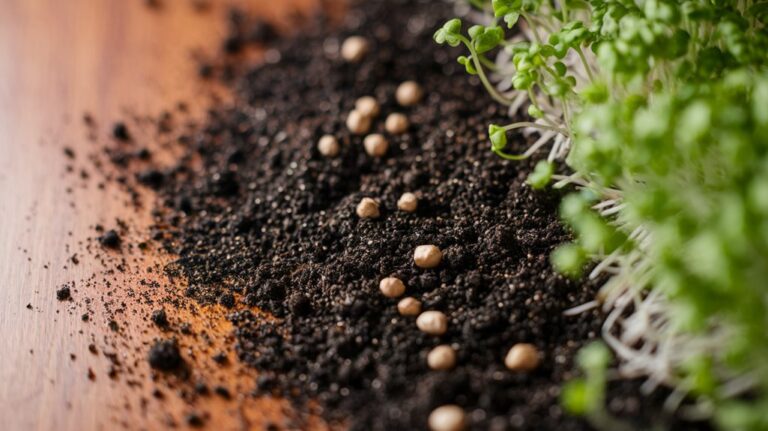
Look closely at a whole coriander seed and you will see a small, round husk with ridges. That husk is not a single seed. It is a dried fruit.
Alberta Agriculture describes the coriander fruit as nearly round and made of two single-seeded halves. Botanists call this kind of fruit a schizocarp.
This matters for your tray. A whole seed can send up two seedlings from the same spot, while the tough husk slows water from getting in. Seed companies solve both problems by splitting the fruit in half. True Leaf Market explains that split seed has the individual seeds separated from the pod, which makes even sowing much easier.
It wants a cool room, not a warm one
Cilantro is a cool-season plant. Oregon State University Extension says the seeds germinate at soil temperatures of 55 to 68°F.
True Leaf Market makes the same point for microgreens specifically: cilantro grows slowly and prefers temperatures under 70°F, especially during germination.
Compare that with basil microgreens, which want 75 to 85°F. If you grow both, do not put them on the same heat mat. A cool basement shelf or a spot away from the furnace vent is often perfect for cilantro.
It is slow, and it sprouts unevenly
Radish is up in a day or two. Cilantro is not.
Green Harvest notes that coriander germinates erratically, anywhere from 6 to 12 days. True Leaf Market lists 7 to 10 days to germinate and 21 to 28 days to harvest. Johnny’s Selected Seeds reports 20 days in its own trial when harvested at the first true leaf.
The most common beginner mistake is giving up on day 5 and tipping the tray into the compost. Give it at least 10 days before you decide anything went wrong.
Split seed vs whole seed: which should you buy?
| Split seed | Whole seed | |
|---|---|---|
| What it is | The fruit cracked into two single seeds | The intact round husk holding two seeds |
| Germination | Faster and more even | Slower. Water has to get through the husk |
| Sowing | Easy to spread evenly | Seedlings can come up in pairs and clumps |
| Prep needed | None. Sow it dry | Crack it gently, and soak if you like |
| Where to find it | Microgreen seed suppliers | Garden seed packets, sometimes the spice aisle |
Our pick: buy split seed if you can find it. It is the single biggest upgrade you can make to a cilantro tray.
If you only have whole seed, put it in a zip bag and roll over it gently with a rolling pin, just hard enough to crack the husks. Some growers also soak it. Sprouting.com, for example, soaks its cilantro seed for about 4 hours before sowing, while Sproutpeople skips soaking and simply sows onto a well-moistened medium. Both approaches work.
About spice-aisle coriander: it is the same plant, so it may grow. But spice seed is sold for cooking, not planting, so germination is a gamble. Try a small test tray before you sow a full one.
How to grow cilantro microgreens, step by step
- Prepare the tray. Fill a shallow tray with 1 to 1.5 inches of moist potting mix or coco coir and press it flat. True Leaf Market describes cilantro as very difficult to grow hydroponically, so skip bare hemp or jute mats for this crop. If you like soil-free growing, coir is the better choice. Our guide to growing microgreens without soil compares the options.
- Sow the seed. Spread about 1 oz across a 10×20 tray, or 1 to 3 teaspoons across a 5×5 inch tray. Cilantro needs a little more space than most microgreens because it grows longer and leafier.
- Mist and press. Mist the seeds lightly, then press them gently into the surface with your palm or a flat tray. Good seed-to-soil contact helps the slow starters.
- Cover and keep it dark and cool. Put an upside-down tray or a dome over the top. Keep the tray somewhere around 60 to 70°F. Sproutpeople suggests not watering the seeds again until after they germinate, as long as the medium started out thoroughly moist. Check every day or two and mist only if the surface dries out.
- Uncover once most seeds are up. This usually takes 4 to 7 days, sometimes longer. When most seedlings are standing and lifting their husks, remove the cover and move the tray to light.
- Give it steady light. A bright window works, but cilantro grows slowly enough that short fall days can leave it pale and stretched. A small LED light makes a real difference here. Our post on whether microgreens need grow lights explains how to set one up.
- Bottom water from now on. Pour water into a solid tray underneath and let the roots drink for 10 to 15 minutes, then drain. This keeps the leaves dry and lowers the risk of mold over the long grow.
- Harvest at the cotyledon or first true leaf stage. You can cut once the two long, narrow seed leaves have opened, or wait for the first frilly true leaf, which tastes more like the cilantro you know. Cut just above the soil with sharp scissors. Stop watering about 12 hours before harvest so the greens are dry.
Are cilantro microgreens healthy? What the numbers show
Cilantro is one of the standouts in the best-known microgreen nutrition study. In 2012, USDA and University of Maryland researchers tested 25 commercially grown microgreens and found that cilantro had the highest concentration of carotenoids of all of them (Xiao et al., Journal of Agricultural and Food Chemistry).
Carotenoids are the pigments your body uses for vision and to make vitamin A. Here is how cilantro microgreens compare with USDA figures for mature cilantro leaves (USDA data via SouperSage).
| Nutrient (per 100 g) | Cilantro microgreens | Mature cilantro leaves |
|---|---|---|
| Beta-carotene | 11.7 mg | 3.9 mg |
| Lutein and zeaxanthin | 10.1 mg | 0.9 mg |
What this tells a home grower:
- Beta-carotene is about 3 times higher in the microgreens. Mississippi State University Extension cites the same threefold increase from the study.
- Lutein and zeaxanthin are roughly 11 times higher. These are the carotenoids that collect in the eye. The study’s own range for lutein and zeaxanthin topped out at 10.1 mg per 100 g, the cilantro figure.
- The USDA summary puts it simply. Across all 25 crops, microgreens averaged about five times more vitamins and carotenoids than their mature versions.
An honest caveat: these were commercially grown samples, and the USDA notes that growing, harvesting, and handling conditions can change nutrient levels a lot. You also will not eat 100 g of cilantro in one sitting. Treat micro cilantro as a flavor ingredient that happens to carry more carotenoids per bite than the bunch from the store.
For the wider picture, see how other crops stack up in our breakdown of microgreens vs. spinach and kale.
Why does cilantro taste like soap to some people?
If someone at your table says cilantro tastes like dish soap, they are not being fussy. There is a real genetic reason.
A large study by 23andMe linked the soapy taste to a group of smell receptor genes that includes OR6A2, a receptor that detects the aldehydes in cilantro leaves. A separate University of Toronto study published in the journal Flavour found that between 3% and 21% of people dislike cilantro, depending on their ancestry (Mauer and El-Sohemy, 2012).
Micro cilantro will not change that for anyone with the gene. If your household is split, grow a small 5×5 tray instead of a full flat, and serve it on the side.
How to store cilantro microgreens
Here is some good news after all that waiting. Unlike basil, cilantro is happy in the fridge.
The SARE Northeast Crop Production and Harvest Manual lists storage for cilantro at 32 to 41°F with very high humidity, and notes that it is moderately sensitive to ethylene. That is the ripening gas given off by fruit like apples and bananas.
- Harvest dry. Cut at least 12 hours after the last watering so the leaves go into storage dry.
- Store in a closed container lined with a dry paper towel, in the crisper drawer.
- Keep it away from the fruit drawer. Ethylene speeds up yellowing.
- Better yet, cut to order. A living tray on the counter keeps longer than anything in a bag.
Our full guide to storing and freezing microgreens covers more options.
Common cilantro microgreen problems and fixes
| Problem | Likely cause | Fix |
|---|---|---|
| Nothing has sprouted after 5 days | Normal for cilantro | Keep it covered, moist, and cool. Wait until day 10 to 12 |
| Very patchy germination | Room too warm, or whole seed used | Move to a cooler spot. Use split seed next time |
| Seedlings in tight pairs and clumps | Whole seed, two seeds per husk | Switch to split seed, or crack whole seed before sowing |
| Seed husks stuck on the leaves | Normal as cilantro pushes up through its husk | Mist gently or brush off with your fingers before harvest |
| Long, pale, floppy stems | Not enough light over a long grow | Add a grow light or move closer to a bright window |
| Poor growth on a hemp or jute mat | Cilantro struggles on bare hydroponic media | Grow in soil or coco coir instead |
| Fuzzy gray growth and a musty smell | Mold from overwatering and poor airflow | Bottom water, add a small fan, and sow a little thinner |
If your tray still is not cooperating, our guide to why your microgreens aren’t growing covers the problems that affect every crop.
Cilantro microgreens FAQ
Do cilantro microgreens grow back after cutting?
No. Epic Gardening notes that cilantro microgreens will not regrow, because the growing points are removed when you cut. Sow a new tray every week or so for a steady supply.
Should you soak cilantro seeds before planting microgreens?
Split seed does not need it. Whole seed sprouts faster if you crack the husks first, and you can soak it for a few hours as well. Either way, sow onto a thoroughly moist medium and keep the seeds covered until they sprout.
How long do cilantro microgreens take to grow?
Expect 16 to 28 days from sowing to harvest. Germination alone takes about 7 to 10 days, and it is often uneven. A cool room around 55 to 68°F gives the best germination.
Do cilantro microgreens taste like regular cilantro?
Yes, with a softer edge. Greenhouse Megastore describes the first seed leaves as grass-like and slightly milder. Once the first true leaves appear, the flavor is full cilantro. Sproutpeople describes it as full cilantro flavor in a very tender leaf.
Can you grow cilantro microgreens on a windowsill?
Yes. A cool, bright windowsill in fall or winter suits cilantro better than a hot summer one. Just watch for stretching on short days. If the stems turn pale and floppy, a small grow light will fix it.
What is the difference between cilantro and coriander microgreens?
They are the same plant, Coriandrum sativum. In North America the leaves are called cilantro and the seeds are called coriander. In the UK and many other countries, both are called coriander.
Start your first tray this week
Cilantro asks for patience, but the rules are short. Buy split seed, keep it cool and covered until it sprouts, give it steady light, and bottom water.
Start with a 5×5 tray this week. While you wait, sow a fast crop beside it, like arugula or kale, so there is always something to harvest.
When your cilantro is ready, scatter it over tacos, pho, or a bowl of dal. Or blend a handful into a batch of microgreen pesto for a bright, citrusy twist on the classic.