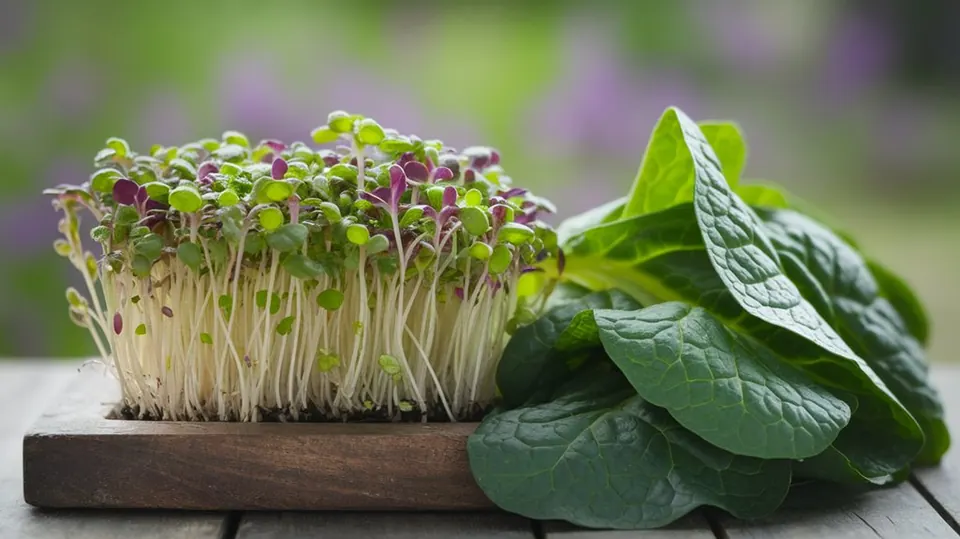
Microgreens vs. Spinach and Kale: What the Numbers Actually Show
Are microgreens more nutritious than spinach and kale?
Yes — for most vitamins and antioxidants, microgreens are more nutrient-dense per gram than mature spinach or kale. A USDA-backed study found microgreens contain on average five times more vitamins and carotenoids than equivalent mature greens, with certain varieties showing 40 times the concentration of specific nutrients. Mature greens still lead on dietary fibre and are cheaper and easier to find. But the nutrient density gap is real and larger than most people expect.
Here is the assumption most people carry into the supermarket: spinach and kale are the healthiest greens you can eat.
It is a reasonable assumption. Decades of nutrition advice, recipe books, and smoothie culture have cemented kale and spinach as the gold standard — the greens you reach for when you are trying to eat well.
The research says the picture is more interesting than that.
What follows is what the data actually shows: where microgreens outperform mature greens, where spinach and kale still hold their own, and why growing your own microgreens at home changes the calculation entirely.
Where the data comes from
The most widely cited research on this question comes from a study conducted by the University of Maryland in partnership with the USDA, published in the Journal of Agricultural and Food Chemistry.
Researchers measured concentrations of vitamins C, E, and K, along with key carotenoids (beta-carotene, lutein, zeaxanthin), across 25 microgreen varieties – comparing the microgreen stage to the same plant at full maturity.
The headline finding: microgreens contained on average five times the concentration of vitamins and carotenoids as the equivalent mature plant. For specific varieties and specific nutrients, the ratio was as high as 40 times.
That is not a supplement claim or a marketing number. It is a peer-reviewed measurement. And it forms the foundation of everything that follows.
The comparison by nutrient
| Nutrient | Microgreens | Mature spinach | Mature kale | Notes |
|---|---|---|---|---|
| Vitamin C | Very high — up to 147 mg/100g depending on variety | ~28 mg/100g | ~93 mg/100g | Varies significantly by microgreen variety |
| Vitamin E | Exceptionally high in some varieties (daikon radish: 87.4 mg/100g) | ~2 mg/100g | ~1.5 mg/100g | Microgreens are among the richest food sources |
| Vitamin K | High – red cabbage microgreens have 69x the K of mature red cabbage | ~483 µg/100g | ~705 µg/100g | Kale is a strong competitor here |
| Beta-carotene | High in most varieties | High | High | Mature greens compete well |
| Sulforaphane | Very high in broccoli and red cabbage microgreens | Absent | Very low | No mature green comes close |
| Iron | Low-moderate | High (~2.7 mg/100g) | Moderate | Spinach has a clear advantage |
| Calcium | Low-moderate | Moderate (~99 mg/100g) | High (~135 mg/100g) | Kale has a clear advantage |
| Dietary fibre | Low | High (~2.2 g/100g) | High (~3.6 g/100g) | Mature greens win clearly |
| Protein | Low–moderate | Moderate | Moderate | Roughly comparable |
Sources: USDA/University of Maryland study; USDA FoodData Central. Microgreen figures vary by variety — values above reflect strong-performing varieties rather than averages across all types.
Where microgreens clearly win
Vitamin C. The range across 25 microgreen varieties in the USDA study ran from 20 mg to 147 mg per 100g fresh weight. The higher end of that range comfortably exceeds spinach (~28 mg) and competes with kale (~93 mg) – from a portion you could hold in one hand.
Vitamin E. This is the most dramatic gap. Green daikon radish microgreens measured 87.4 mg of alpha-tocopherol per 100g in the USDA study. Mature spinach contains roughly 2 mg per 100g. That is a difference of more than 40 to one. Most people would never think of microgreens as a vitamin E source – the data says they should.
Vitamin K. Red cabbage microgreens showed 69 times the vitamin K of mature red cabbage in the same study. Even compared to kale – which is an exceptional vitamin K source – many microgreens hold their own or exceed it.
Sulforaphane and glucosinolates. This is the category where no mature green comes close. Broccoli and red cabbage microgreens contain concentrations of glucosinolates and sulforaphane that are simply not available in meaningful quantities from any mature leafy green. If this category matters to you – and the research on sulforaphane suggests it should – microgreens are in a different league.
Antioxidant density overall. A 2025 study published in Food Chemistry confirmed that microgreens consistently outperform their mature counterparts on antioxidant activity, with the advantage driven by higher concentrations of polyphenols and carotenoids in the seedling stage.
Where spinach and kale still hold their own
Let us be honest about what the comparison does not show, because this matters.
Dietary fibre. Microgreens are harvested young. They have not yet built the fibrous cell walls of a mature plant. Spinach and kale are both meaningfully higher in fibre per 100g – and fibre is essential for digestion, blood sugar regulation, and gut health in ways that vitamins alone cannot replicate. If you swap your mature greens entirely for microgreens, you lose this.
Iron. Spinach is one of the better plant-based iron sources available. Microgreens generally do not match it on this measure. If iron is a priority in your diet – as it is for many women and plant-based eaters — spinach earns its place on the plate.
Calcium. Kale is an excellent calcium source, particularly for people who avoid dairy. Most microgreens do not compete with it here.
Affordability and availability. A bag of spinach or a bunch of kale is inexpensive and available in almost every supermarket. Microgreens require either growing your own or buying at a premium. If cost is a constraint, mature greens are the more accessible nutrient source.
The honest conclusion from the data: microgreens do not replace spinach and kale. They add something the mature greens cannot.
The freshness factor and why it favours the home grower
Here is the part of this comparison that rarely appears in mainstream coverage.
Both microgreens and mature greens lose nutritional value after harvest. Vitamin C begins degrading within 24 hours of cutting. Carotenoids and antioxidants follow. By the time a bag of spinach has been transported, packaged, shelved, and sat in your fridge for three days, a meaningful portion of what made it nutritious on the day of harvest has diminished.
The same is true of commercially grown microgreens – which are often several days old by the time they reach the shelf.
When you grow microgreens at home and harvest them the morning you eat them, you are eating at peak nutrition. There is no transit. No shelf time. No nutrient loss to cold storage.
That freshness advantage is something no supermarket – however good its supply chain — can offer you. And it applies to both microgreens and home-grown sprouts.
The cost argument shifts when you grow your own
The main practical objection to microgreens is price. A small punnet from a supermarket or market stall can cost several times what a bag of spinach costs for the same volume.
That calculation changes when you grow your own.
A packet of broccoli or radish microgreen seeds, enough for many trays, costs a few dollars and is available year-round. A single 10×20 tray produces enough microgreens for multiple servings in around ten days, using little more than seeds, water, and a container you already own. Per serving, home-grown microgreens are among the cheapest nutrient-dense foods you can eat.
The cost premium disappears. What remains is the nutritional advantage.
How to use both – a practical guide
This is not a competition with a single winner. The most nutritionally complete approach uses both, playing to each one’s strengths.
Reach for microgreens when you want:
- Concentrated vitamins C, E, and K in small volume
- Sulforaphane and glucosinolates (broccoli, red cabbage, radish microgreens)
- The freshest possible greens harvested that day
- A nutrient boost without bulk – on eggs, in sandwiches, in a smoothie, on soup
Reach for spinach and kale when you want:
- Dietary fibre for digestive health
- Iron from a plant source (spinach)
- Calcium (kale)
- Volume – a satisfying portion of something substantial
- A base for salads and cooked dishes
The most practical setup for most home growers: keep one or two trays of microgreens running on the counter, buy spinach or kale for cooked meals and salads. Add a small handful of microgreens at the end – on top, not in place of the mature greens.
You get the fibre from the kale. You get the concentrated vitamins from the microgreens. The nutrient profile of your meal improves without any extra effort.
The varieties that outperform the most
Not all microgreens are equal. If you want the most nutritional impact from what you grow, these varieties consistently rank at the top of the research:
| Microgreen | Stands out for | Compared to mature form |
|---|---|---|
| Red cabbage | Vitamin E, vitamin K, vitamin C, antioxidants | Up to 40x more vitamin E, 69x more vitamin K |
| Broccoli | Sulforaphane, vitamin C | 10-100x more sulforaphane than mature broccoli |
| Green daikon radish | Vitamin E – highest of all 25 varieties studied | 87.4 mg/100g vitamin E vs ~0.6 mg in mature radish |
| Kale | Beta-carotene, vitamin K | High carotenoid content at seedling stage |
| Mustard | Antioxidants, glucosinolates | Stronger at microgreen stage than at maturity |
| Pea shoots | Vitamin C, folate, protein | Notably richer than mature peas in vitamins |
For a full breakdown of varieties and their nutritional profiles, see the seed library.
Start where the data is strongest
If you want to test this with a single tray, red cabbage and broccoli microgreens give you the most nutritional payoff for the effort. Both are easy for beginners, both grow in 7 to 10 days, and both are at the top of the research for nutrient density.
⟶ Ready to grow your first tray? The step-by-step guide to growing microgreens at home walks you through everything from seed to harvest.
⟶ Want to understand the full health picture first? See the top health benefits of microgreens – covering how these nutrients translate into real health outcomes.
⟶ Curious which seeds give you the most variety and nutritional coverage? The seed library has notes on every variety the site recommends.