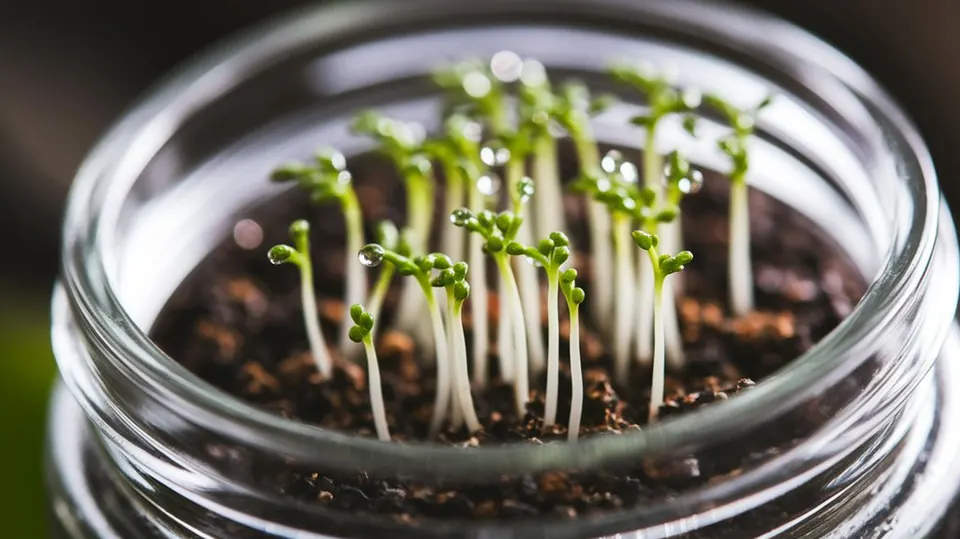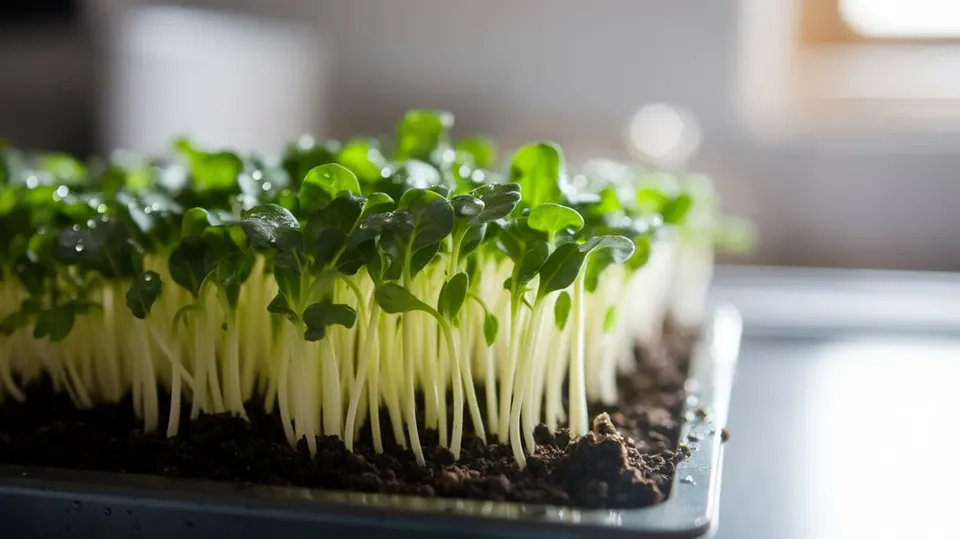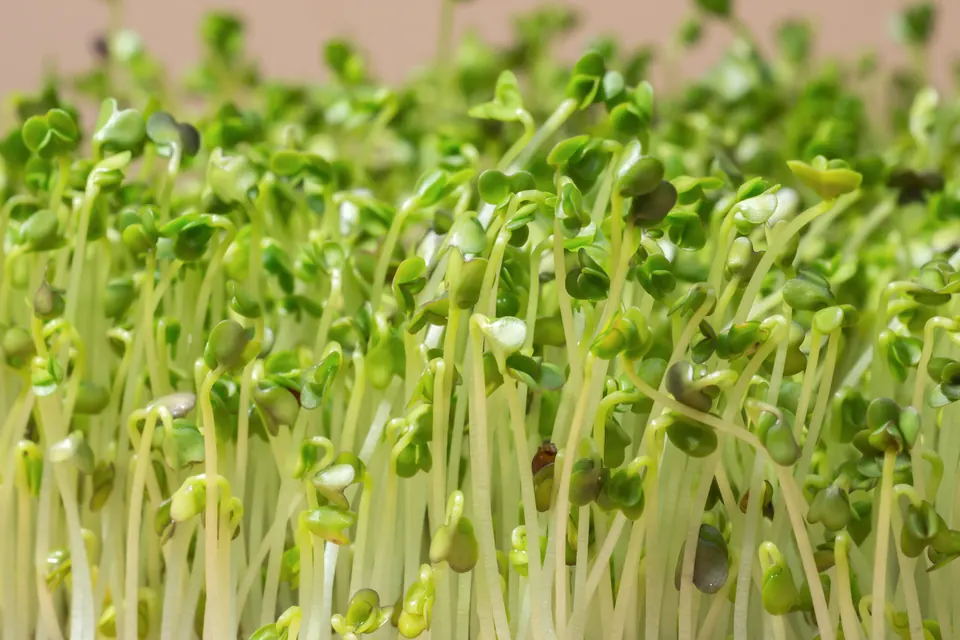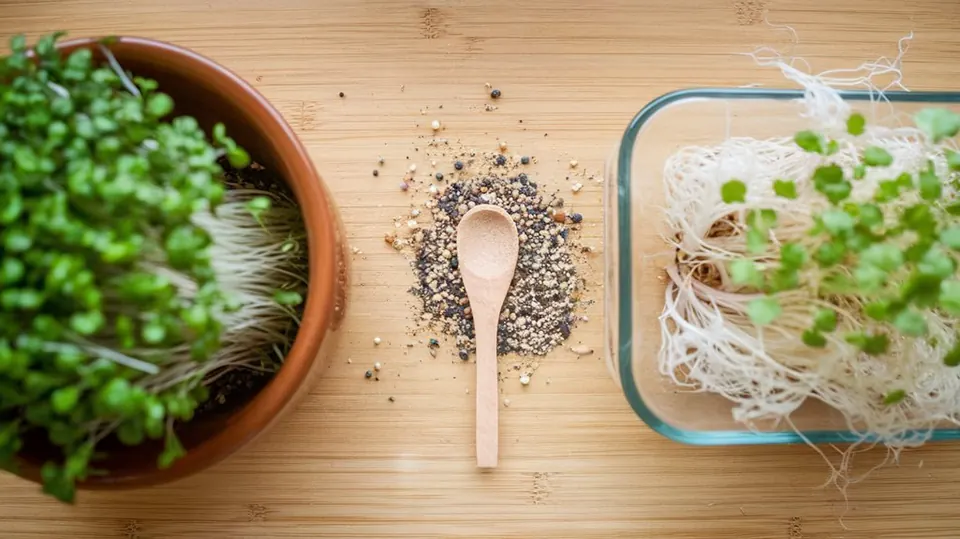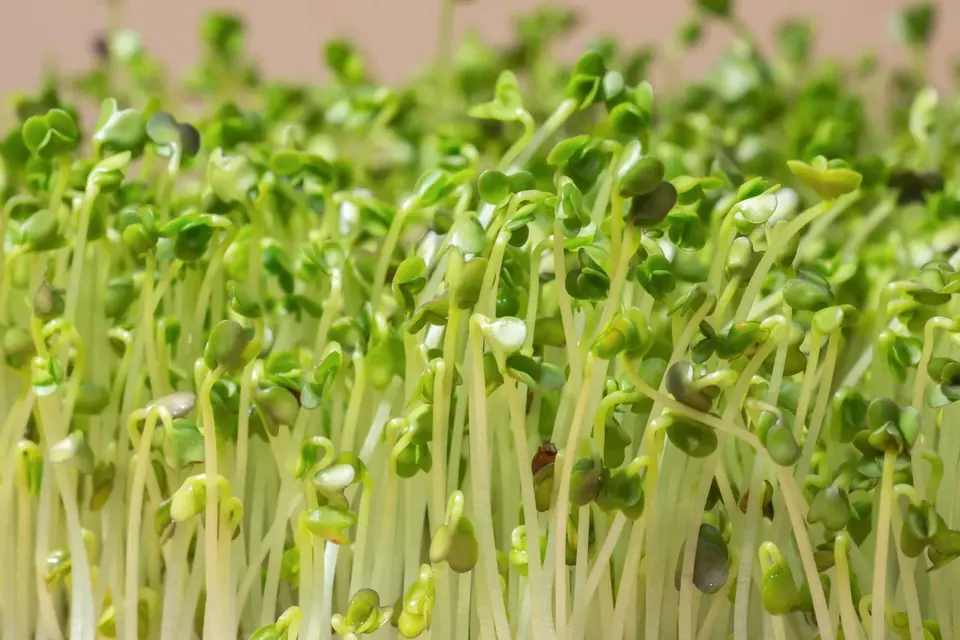
Short answer: broccoli sprouts are 4 to 5-day-old seedlings grown in a jar and eaten whole. Broccoli microgreens are 7 to 10-day-old seedlings grown on soil with light and cut above the roots. Both are good sources of glucoraphanin, which your body turns into sulforaphane. Sprouts are easier and faster; microgreens are leafier and milder. Grow whichever you'll actually eat.
The quick comparison
| Broccoli sprouts | Broccoli microgreens | |
|---|---|---|
| Grown in | A jar, water only | A tray with soil or a mat, plus light |
| Ready in | 4–5 days | 7–10 days |
| What you eat | Seed, root, stem and seed leaves | Stem and seed leaves, cut above the root |
| Taste | Sharp, peppery, crunchy | Milder, leafier, fresh broccoli |
| Seed per batch | 1–2 tbsp per quart jar | About 13–28 g per 10 × 20 tray |
| Equipment | Jar and mesh lid | Two trays, growing medium, light |
| Food safety | Eaten whole, higher risk raw | Cut above roots, usually lower risk |
Broccoli sprouts vs microgreens: sulforaphane
Broccoli became famous for a 1997 Johns Hopkins study that found 3-day-old broccoli sprouts held 10 to 100 times more glucoraphanin than mature broccoli.1 Glucoraphanin is the compound your body turns into sulforaphane when the plant is chewed or chopped.
Microgreens weren't part of that study, and for years they were much less researched. That's changing:
- A 2023 feeding study found broccoli microgreens had about as much glucoraphanin as earlier studies found in broccoli sprouts. People who ate them produced sulforaphane metabolites similar to those seen in sprout studies.2
- A 2021 study of broccoli and kale at different growth stages found glucoraphanin levels varied a lot with the plant variety and growing season, and some of the highest levels were in microgreens and baby leaves.3
The honest summary: both stages are good sources, and the variety and growing conditions matter as much as the stage. Neither is proven to treat or prevent disease. If sulforaphane is your goal, eat either one raw or barely cooked, and chew well or chop them, because that's when the conversion happens.
For the full science, see broccoli sprouts benefits: sulforaphane explained.
Taste and texture
- Sprouts are crisp and sharp, with a bite that's closer to radish than to cooked broccoli. They work well on sandwiches and in wraps.
- Microgreens are softer and leafier, with a sweeter, greener broccoli taste. They're better in salads, on top of soups and in pesto.
Growing time and effort
Sprouts are the easier option. You need a jar, a mesh lid and two minutes a day. Soak 1 to 2 tablespoons of seed for only 1 to 2 hours, then rinse and drain twice a day. They're ready in 4 to 5 days. See how to grow broccoli sprouts.
Microgreens take a little more setup: two trays, a growing medium and a window or light. Sow the seed thickly, keep it dark for 2 to 3 days, then give it light. Cut above the soil at 7 to 10 days. See how to grow broccoli microgreens.
The same broccoli seed works for both.
Food safety
Sprouts are eaten whole, seed and root included, after growing in warm, wet conditions. That's why the FDA says higher-risk groups should not eat raw sprouts, and why Health Canada advises everyone to cook them.45
Microgreens are cut above the roots and grow with light and moving air, so they're usually seen as a lower risk. They still need clean trays, good seed and a wash before eating. If you're in a higher-risk group and want broccoli raw, microgreens are generally the better choice. Ask your doctor if you're unsure.
Broccoli sprouts vs microgreens: which should you grow?
- Grow sprouts if you want the fastest, simplest option and like a sharp, crunchy sprout.
- Grow microgreens if you prefer a milder, leafier green, have a sunny window or a light, and want a lower-risk raw option.
- Grow both. Sprouts are ready while your microgreens are still growing.
Where to buy broccoli seed
We link to broccoli seed from Sprouting.com, sold for both sprouts and microgreens. For more variety, their Broccoli Brassica Blend is a sprouting mix of broccoli, clover, radish, mustard and arugula.
Seeds in this article
Frequently asked questions
Do broccoli sprouts or microgreens have more sulforaphane?
There's no clear winner. Young sprouts are famous for high glucoraphanin, and a 2023 study found broccoli microgreens had about as much as sprouts. The amount varies a lot with variety and growing conditions, so either is a good choice.
Which is easier to grow, broccoli sprouts or microgreens?
Sprouts are easier. They need only a jar, a lid and two rinses a day, and they're ready in 4 to 5 days. Microgreens need a tray, soil or a mat, and light, and take 7 to 10 days.
Which tastes better?
It's personal. Sprouts are crunchy and sharp, closer to radish. Microgreens are leafier and milder, with more of a fresh broccoli flavour. Many people use sprouts in sandwiches and microgreens in salads.
Are broccoli microgreens safer than sprouts?
Microgreens are cut above the roots and grown with light and air, so they're usually seen as a lower food-safety risk than sprouts, which are eaten whole, seed and root included. Clean growing practices still matter for both.

Written by Michael
A passionate sprouting professional sharing practical tips for growing sprouts and microgreens at home. More about Michael
Sources
- Fahey JW, Zhang Y, Talalay P. Broccoli sprouts: an exceptionally rich source of inducers of enzymes that protect against chemical carcinogens. PNAS, 1997. Link
- Sulforaphane bioavailability in healthy subjects fed a single serving of fresh broccoli microgreens. Foods, 2023 (PubMed 37893677). Link
- Effects of growing cycle and genotype on the morphometric properties and glucosinolates amount and profile of sprouts, microgreens and baby leaves of broccoli and kale. Agronomy, 2021. Link
- U.S. Food and Drug Administration. Selecting and Serving Produce Safely. Link
- Health Canada. Food safety tips for sprouts. Link