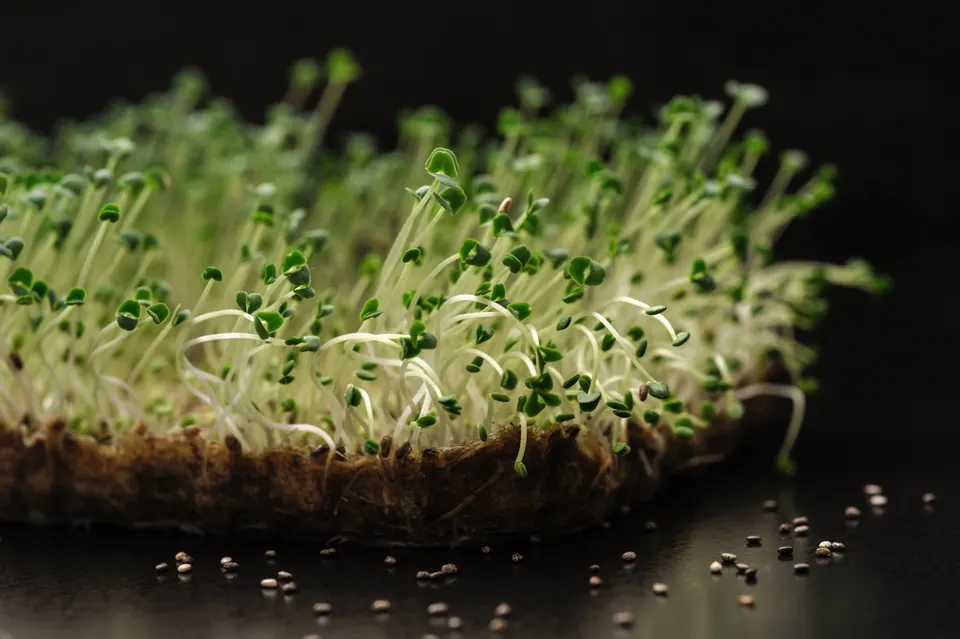
Short answer: don't soak chia. Mist a plate, a terracotta saucer or a tray lined with a damp paper towel or grow mat, then sprinkle the dry seed thinly over it. Mist again, cover loosely to hold in moisture, and mist twice a day. Chia sprouts in 4 to 5 days. Give it light and it turns into small microgreens in 8 to 12 days. Cut above the roots.
What are chia sprouts?
Chia (Salvia hispanica) is a plant in the mint family, best known for its tiny black and white seeds. When the seeds get wet, their outer layer swells into a clear gel, which is why chia pudding works. That same gel makes chia a "gel-forming" seed for sprouting.
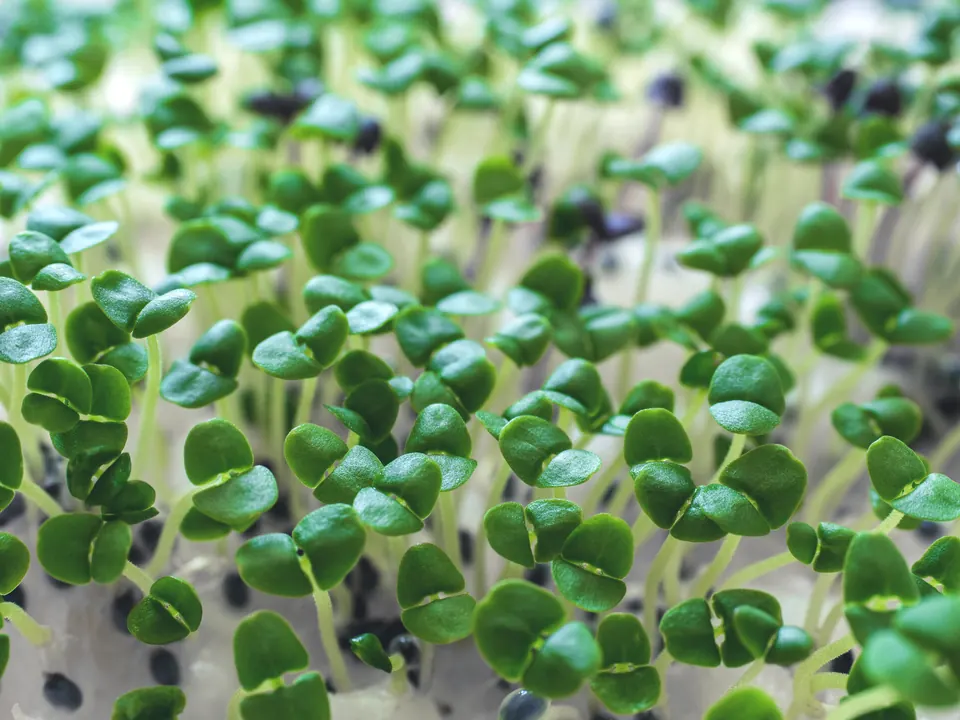
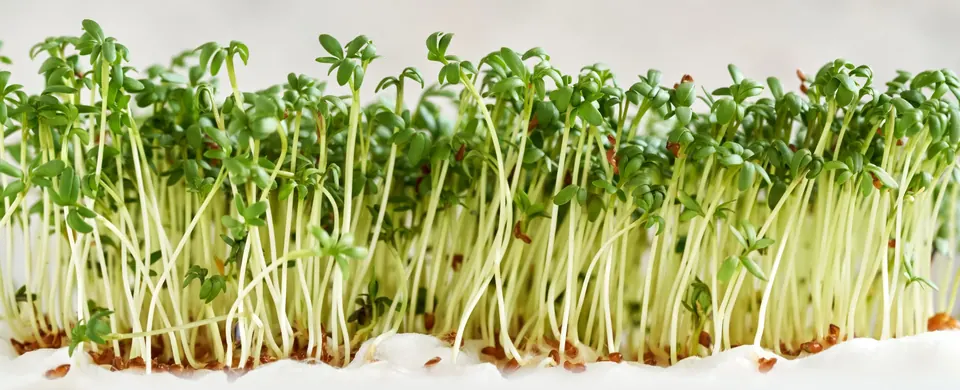
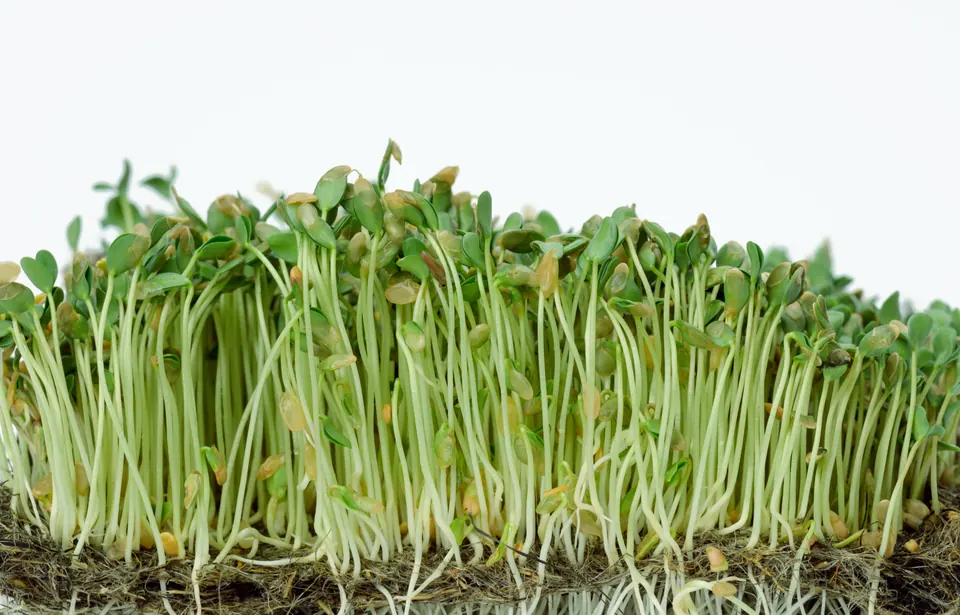
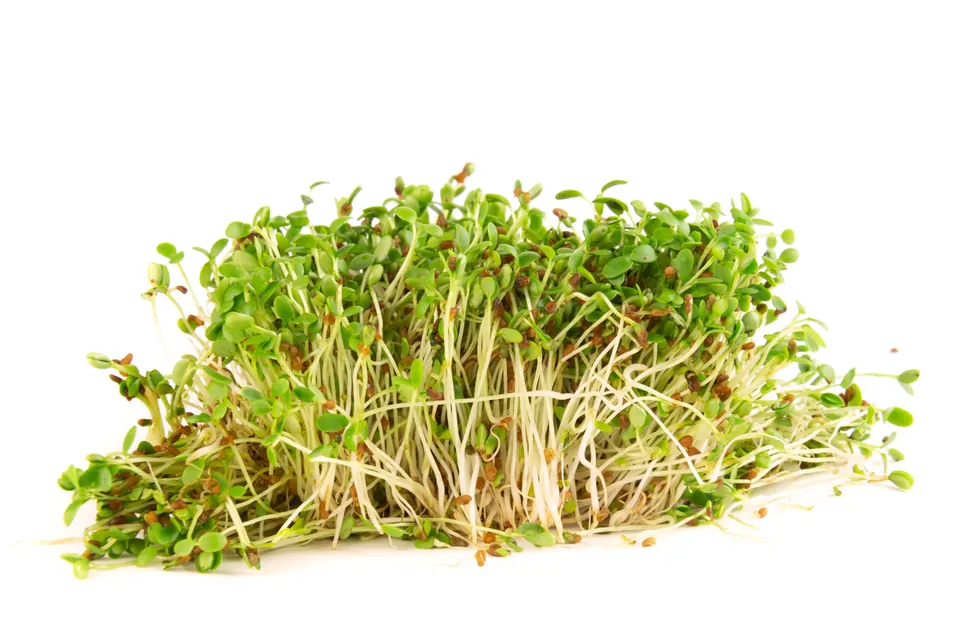
Grown for a few days on a damp surface, chia makes tiny sprouts with two round seed leaves. Left a little longer in light, it becomes a soft, bright green microgreen with a mild, slightly peppery taste, a bit like watercress but gentler.
Why you can't sprout chia in a jar
Most sprouting seeds sit in a jar, get rinsed and drain freely. Chia doesn't drain. Its gel traps water around every seed and glues them together. In a jar you get one wet lump with no air in the middle, and it goes sour or moldy fast.
The fix is to spread the seeds in a single layer on a flat, damp surface and keep them moist by misting instead of rinsing. Other gel-forming seeds, like basil, cress and flax, grow the same way.
What you need
- 1 to 2 tablespoons of chia seed sold for sprouting for a plate, or 15 to 28 g for a full 10 × 20 inch tray
- A flat surface: a plate, an unglazed terracotta saucer or a shallow tray
- A paper towel, hemp mat or thin layer of soil
- A spray bottle
- A loose cover, such as an upturned bowl, a second tray or a clear dome
How to sprout chia, day by day
- Day0
Prepare the surface
Lay a paper towel or grow mat on a plate or tray and mist it until it's evenly damp but not puddled. For microgreens, use a thin layer of moist soil instead.
- Day0
Sprinkle dry seed thinly
Scatter the dry chia seed in a thin, even layer. Leave about a seed-width between seeds. Mist the top until the seeds glisten.
- Day0–3
Cover and mist twice a day
Cover loosely to keep the humidity in. Mist morning and evening so the gel never dries out. Tip off any water that pools.
- Day4–5
Harvest sprouts
When most seeds have a small stem and two seed leaves, cut or pull them off the surface. Rinse them gently and eat them soon.
- Day5–12
Or grow on for microgreens
Uncover them and move them into bright light. Keep misting or water from below. Cut above the roots at 8 to 12 days.
Thin is better. Chia gel holds a lot of water, so a thick layer of seed stays soggy and rots. One even layer, with a little space between seeds, gives the best results.
Clay and terracotta sprouters
Unglazed clay works well for chia. The clay soaks up water and keeps the seeds evenly damp from below, so you mist less. A stacked terracotta sprouting tower lets you grow chia on one level and other seeds on the others.
Chia sprouts nutrition
Dry chia seed is famous for its fiber and omega-3 fat. Sprouts and microgreens are a different food: they're mostly water, like other fresh greens.
A 2020 study found that sprouting changed chia's nutrient profile, including raising some antioxidant compounds as the seeds germinated.1 That's interesting, but it doesn't make a handful of chia sprouts a substitute for the seed. Enjoy them as a fresh, mild green.
Safety
Chia sprouts grown on a plate are eaten whole, so the usual sprout advice applies. The FDA says young children, pregnant people, older adults and anyone with a weakened immune system should not eat raw sprouts of any kind, and Health Canada advises everyone to cook sprouts.23 Chia microgreens are cut above the roots, which lowers the risk but doesn't remove it. Use clean surfaces and good seed, and refrigerate your harvest promptly.
Problems and fixes
| What you see | Likely cause | What to do |
|---|---|---|
| Seeds clumped and sour | Seed too thick or too wet | Spread thinner. Mist instead of pouring water |
| Seeds dried out and stopped | Gel dried up | Keep a loose cover on and mist twice a day |
| Few seeds sprouting | Old or heat-treated seed | Use fresh seed sold for sprouting |
| White fuzz around seeds | Root hairs (normal) or mold | Root hairs are fine and even. Gray, patchy, smelly fuzz is mold: throw it out |
| Leggy, pale microgreens | Not enough light | Move to a bright window or under a light after day 4 |
How to store chia sprouts
Chia sprouts are delicate. Harvest only what you need, pat them dry and keep them in a covered container lined with a paper towel. Eat them within 2 to 3 days. Microgreens keep a little longer, up to about 5 days.
How to eat chia sprouts
- Salads: sprinkle them over greens or grain bowls.
- Sandwiches and toast: add them on top of avocado or soft cheese.
- Smoothies: blend in a handful of microgreens. See 7 microgreens smoothie recipes.
- Garnish: scatter them over soups and eggs.
Where to buy chia seed for sprouting
We link to Sprouting.com, a Canadian company that sells black chia seed for sprouting and microgreens. Seed sold for sprouting is fresher and germinates more evenly than most grocery chia. Store it in a cool, dry place in a sealed jar.
What to grow next
- Basil: another gel-forming seed, grown the same way.
- Curly cress: fast, spicy and easy on a plate.
- Flax: nutty greens from a gel-forming seed.
- Arugula: peppery microgreens, no soaking needed.
Browse every seed in the Seed Library.
Chia FAQ
Can you sprout chia seeds in a jar?
Not well. Chia seeds form a thick gel coating as soon as they get wet. In a jar, the gel glues the seeds into a wet lump that can't drain, and it spoils quickly. Grow chia on a flat surface, such as a plate, terracotta dish or shallow tray, and mist it instead.
How long do chia seeds take to sprout?
You'll see tiny roots in 1 to 2 days and small sprouts with seed leaves in 4 to 5 days. Grown on, chia makes small microgreens in about 8 to 12 days. A warm room around 70°F (21°C) speeds it up.
Should you soak chia seeds before sprouting?
No. Soaking turns chia into a pudding-like gel. Sprinkle the dry seed on a damp surface and mist it. The gel that forms on each seed holds water and helps it stick to the surface while it sprouts.
Are chia sprouts healthy?
Chia sprouts and microgreens are fresh greens with a mild taste. Lab studies show that germination changes chia's nutrient profile and can raise some antioxidant compounds. Sprouts are mostly water, though, so a handful gives far less fat and fiber than a spoonful of dry chia. Think of them as a fresh green, not a seed substitute.
Can you sprout grocery store chia seeds?
Sometimes. Many grocery chia seeds are old or heat-treated and sprout poorly. Seed sold for sprouting is fresher and tested for germination, so it gives a fuller, more even tray.

Written by Michael
A passionate sprouting professional sharing practical tips for growing sprouts and microgreens at home. More about Michael
Sources
- Beltrán-Orozco MC, Robles-Ramírez MC. Changes in the nutritional composition and antioxidant capacity of chia seeds during germination process. Food Science and Biotechnology, 2020. Link
- U.S. Food and Drug Administration. Selecting and Serving Produce Safely. Link
- Health Canada. Food safety tips for sprouts. Link