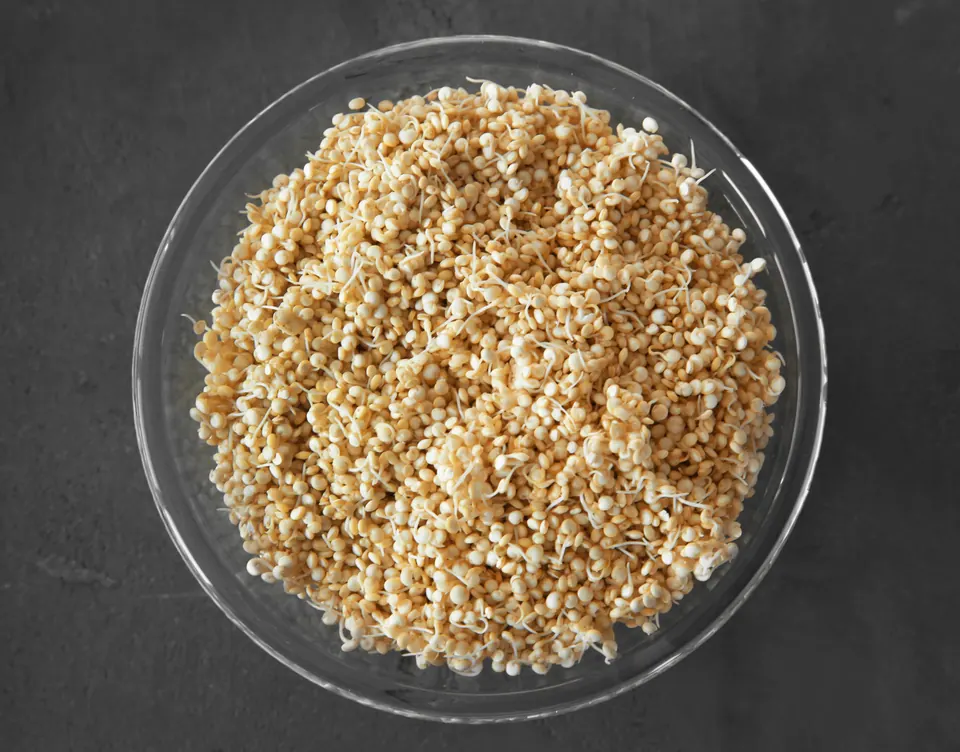
Short answer: rinse ½ cup of raw white or black quinoa very well to wash off its bitter coating. Soak it in cool water for 4 to 8 hours, drain, then rinse and drain twice a day in a jar with a fine mesh lid. It's ready in 2 to 3 days, when the tails are about as long as the seed.
What is sprouted quinoa?
Quinoa (Chenopodium quinoa) is a seed from the Andes that's cooked like a grain. It's one of the fastest seeds to sprout: tiny white tails often appear less than a day after soaking. Sprouted quinoa has a soft, nutty bite and can be eaten raw in salads or cooked like regular quinoa in a fraction of the time.
Sprouting quinoa: wash off the saponins first
Quinoa seeds are naturally coated in saponins, compounds that taste bitter and soapy and that protect the seed in the field. Much of the bitterness of quinoa comes from these saponins, and washing removes a lot of them.1 Most packaged quinoa has been pre-washed, but another good rinse before sprouting makes a big difference.
Put the quinoa in a fine sieve and rinse it under cool running water for a minute, rubbing the seeds between your fingers. If the water foams, keep rinsing until it runs clear.
What you need
- ½ cup (about 85 g) of raw white or black quinoa
- A fine-mesh sieve for rinsing
- A 1-quart (1-liter) jar with a fine mesh lid (quinoa slips through wide screens)
- A bowl to drain the jar upside down
Sprouting quinoa, day by day
- Day0
Rinse well, then soak for 4–8 hours
Rinse the quinoa in a sieve until the water runs clear. Put it in the jar, cover it with cool water and soak for 4 to 8 hours.
- Day1
Drain and rinse
Drain the soak water. Rinse again and drain well. Set the jar upside down at an angle in a bowl.
- Day1–2
Rinse twice a day
Rinse and drain morning and evening. Tails often appear by the first evening.
- Day2–3
Harvest
When the tails are about as long as the seed, give a final rinse, drain well and refrigerate.
Sprouting.com lists 2 to 3 days for both white and black quinoa, with a 4 to 8 hour soak.2
Don't let it run long. Quinoa sprouts very fast. Past day 3, the tails get long and stringy and the flavour turns grassy. Check it each morning and harvest as soon as it's ready.
How much you get
Sprouting.com gives about ½ cup of sprouts per tablespoon of dry quinoa.2 Half a cup of dry quinoa makes roughly 1½ to 2 cups of sprouted quinoa.
White vs black quinoa
| White quinoa | Black quinoa | |
|---|---|---|
| Taste | Mild and soft | Earthier, slightly crunchier |
| Look | Cream with white tails | Black with white tails |
| Best for | Everyday salads and bowls | Salads where colour matters |
| Days | 2–3 | 2–3 |
Sprouted quinoa nutrition
Quinoa is often praised for having all nine amino acids your body can't make on its own, which is less common in plant foods. Sprouting doesn't remove that. Sprouting can also lower phytate in seeds and grains, which may make some minerals easier to absorb, though results vary.3 Treat sprouted quinoa as a quicker, fresher way to eat a food that's already good for you.
Safety
Sprouted quinoa is eaten whole like any sprout. The FDA says higher-risk groups should not eat raw sprouts, and Health Canada advises everyone to cook them.45 Cooking is easy: simmer sprouted quinoa in a little water for 5 to 10 minutes, or toast it in a dry pan.
Problems and fixes
| What you see | Likely cause | What to do |
|---|---|---|
| Bitter, soapy taste | Saponins not rinsed off | Rinse longer before soaking, and again after |
| No tails after 2 days | Heat-treated or old quinoa | Use raw quinoa sold for sprouting |
| Seeds washing through the lid | Mesh too wide | Use a fine screen or cheesecloth |
| Sour smell | Poor draining | Drain well and spread the seed along the jar |
How to store sprouted quinoa
Drain sprouted quinoa well, then refrigerate it in a covered container. It keeps about 3 to 4 days. You can also dry it in a low oven or dehydrator and keep it in a jar to cook later.
How to eat sprouted quinoa
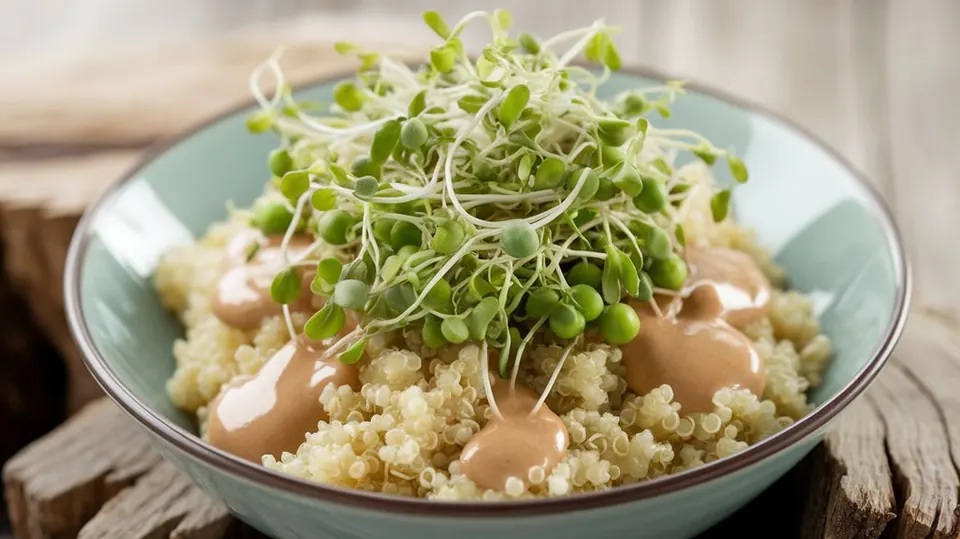
- Salads and bowls: use it like cooked quinoa. See the pea sprout quinoa bowl.
- Quick-cooked: simmer it for 5 to 10 minutes as a side dish.
- Porridge: cook it in milk with cinnamon.
- Baking: add a handful to bread dough or muffin batter.
Where to buy quinoa for sprouting
We link to Sprouting.com, a Canadian company that sells raw white and black quinoa for sprouting. Store it in a cool, dry place in a sealed jar.
What to sprout next
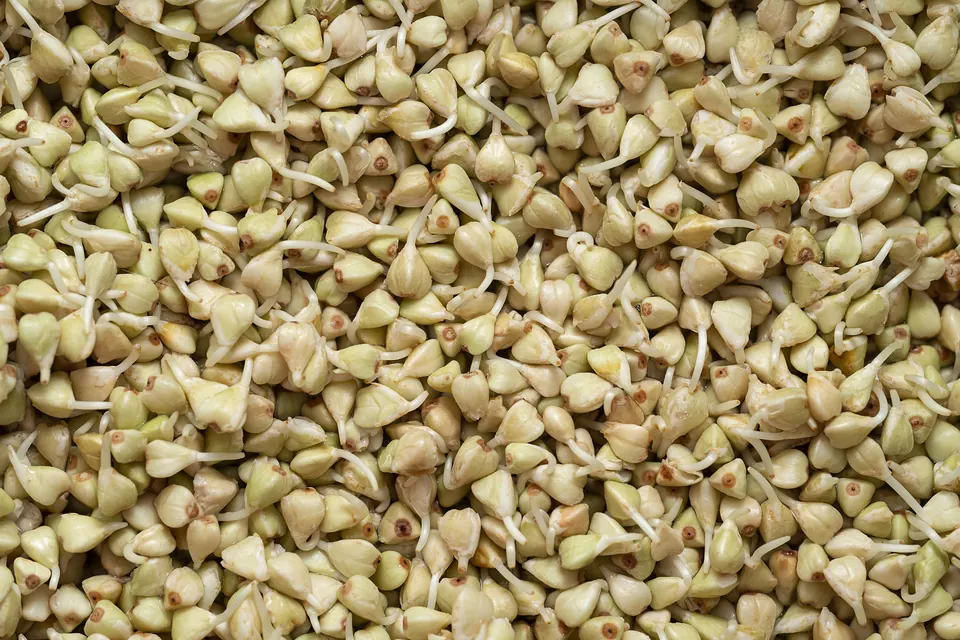
- Buckwheat: another fast, gluten-free seed.
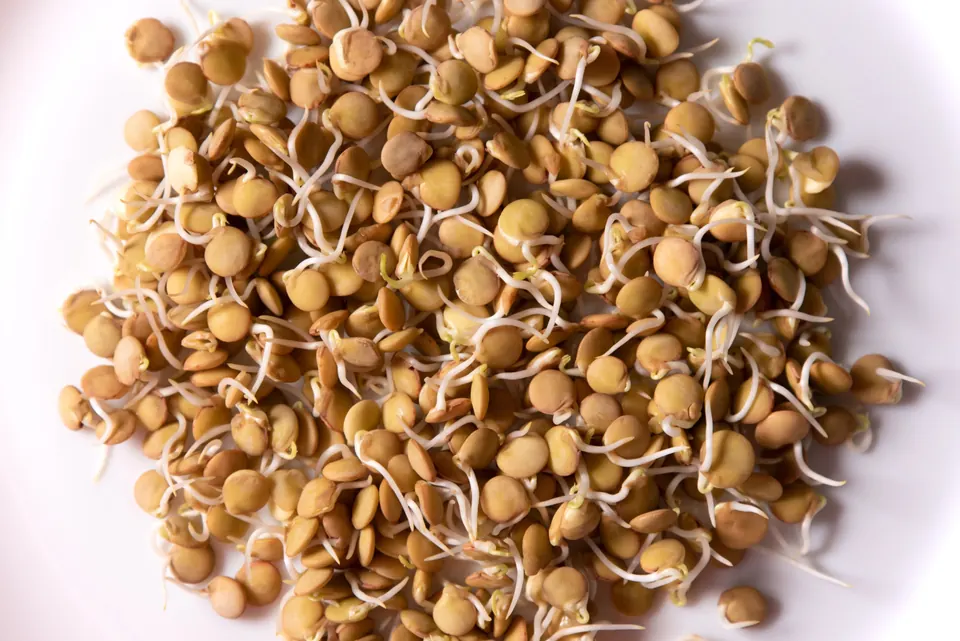
- Lentils: filling sprouts in 2 to 3 days.
- Brown rice: a slower grain sprout.
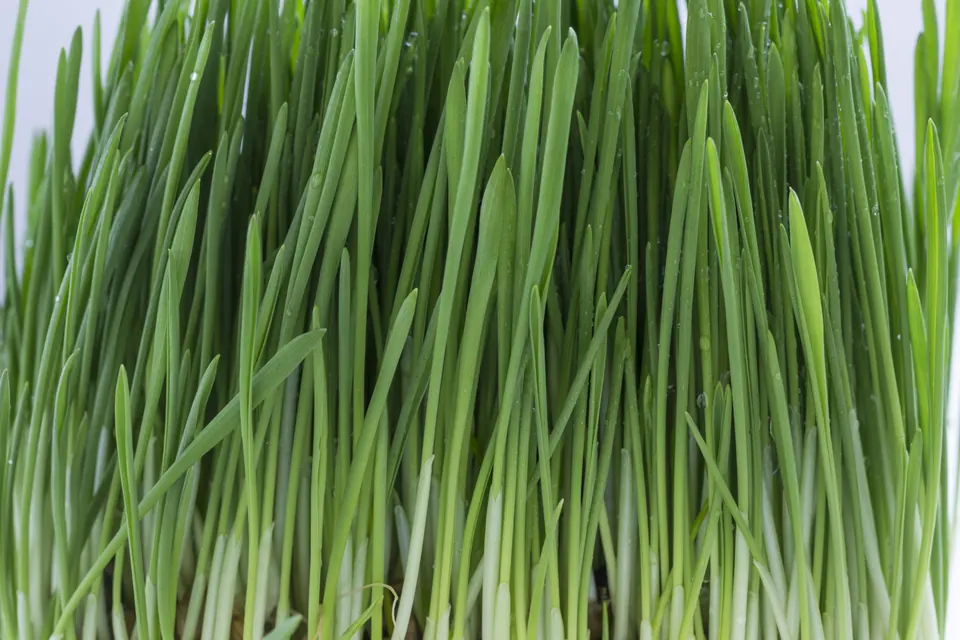
- Oats: sweet sprouts from hulless oats.
Browse every seed in the Seed Library.
Recipes with quinoa
Quinoa FAQ
How long does quinoa take to sprout?
Very little time. Tiny tails often appear within 12 to 24 hours of soaking, and quinoa is ready in 2 to 3 days. Eat it when the tails are about as long as the seed. Longer tails turn it soft and grassy.
Why is my sprouted quinoa bitter?
Quinoa seeds are coated in saponins, natural compounds that taste bitter and soapy. Rinse the seed well under running water, rubbing it between your fingers, before you soak it. Rinsing well again after soaking helps too.
Can you sprout any quinoa?
Only raw, whole quinoa. Some store quinoa is heat-treated or old and sprouts poorly. White and black quinoa sold for sprouting give the most reliable results. Red quinoa usually sprouts too, if it's raw.
Can you eat sprouted quinoa raw?
Many people do, in salads and bowls. Raw sprouts carry a food-safety risk, though. The FDA says higher-risk groups should not eat raw sprouts, and Health Canada advises everyone to cook them. Sprouted quinoa cooks in about 5 to 10 minutes.
How much does quinoa grow when sprouted?
Sprouting.com gives a yield of about ½ cup of sprouts from 1 tablespoon of dry quinoa. So ½ cup of dry quinoa makes roughly 1½ to 2 cups of sprouts.

Written by Michael
A passionate sprouting professional sharing practical tips for growing sprouts and microgreens at home. More about Michael
Sources
- Suárez-Estrella D, et al. Quinoa bitterness: causes and solutions for improving product acceptability. Journal of the Science of Food and Agriculture, 2018. Link
- Sprouting.com (Mumm's Sprouting Seeds). Quinoa, White and Quinoa, Black: days to sprout, soak time and yield. Link
- Elliott H, Woods P, Green BD, Nugent AP. Can sprouting reduce phytate and improve the nutritional composition and nutrient bioaccessibility in cereals and legumes? Nutrition Bulletin, 2022. Link
- U.S. Food and Drug Administration. Selecting and Serving Produce Safely. Link
- Health Canada. Food safety tips for sprouts. Link