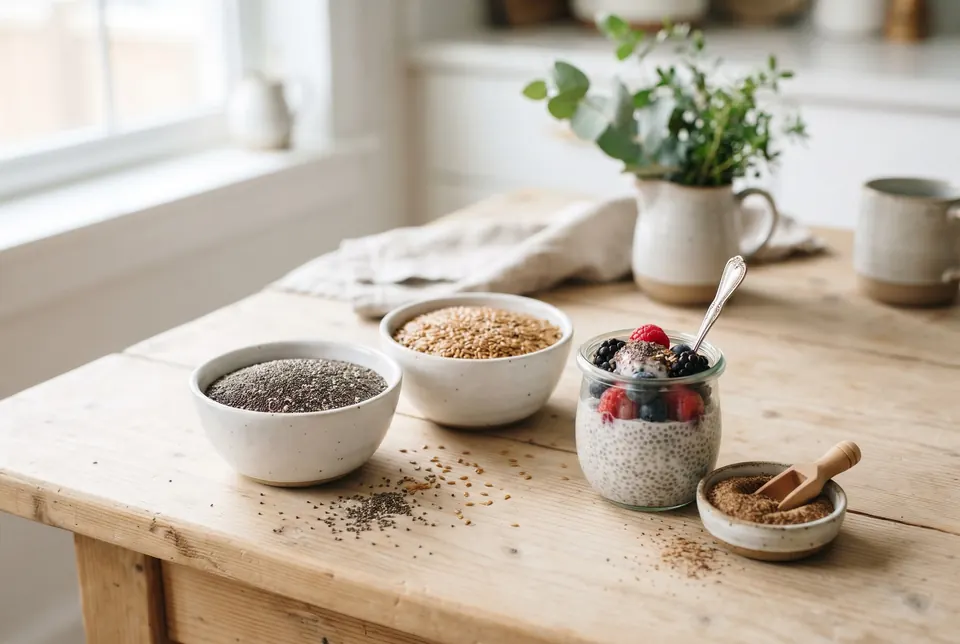
Short answer: chia seeds vs flax seeds is a close match. Per ounce, flax has more omega-3 (6.4 g vs 5 g ALA), more potassium and more thiamin, and it's the better-known source of lignans. Chia has more fibre (9.6 g vs 7.6 g) and about 2½ times the calcium. Grind flax before eating it. Soak chia before eating it.
Chia seeds vs flax seeds at a glance
Here are the two seeds side by side, per ounce (28 g), from USDA FoodData Central.1
| Per 1 oz (28 g) | Chia seeds | Flax seeds |
|---|---|---|
| Calories | 136 | 150 |
| Protein | 4.6 g | 5.1 g |
| Fat | 8.6 g | 11.8 g |
| ALA omega-3 | 5.0 g | 6.4 g |
| Fibre | 9.6 g | 7.6 g |
| Calcium | 177 mg | 71 mg |
| Magnesium | 94 mg | 110 mg |
| Iron | 2.2 mg | 1.6 mg |
| Potassium | 114 mg | 228 mg |
| Thiamin (B1) | 0.17 mg | 0.46 mg |
| Eat it | Whole, soaked first | Ground |
| In liquid | Turns into a thick gel | Thickens a little |
| Taste | Almost none | Mild, nutty |
The short version: they're both good. The differences are in the details, and in how easy each one is to use.
Omega-3: flax wins
Both seeds are high in ALA (alpha-linolenic acid), the omega-3 fat found in plants. Flax has more: about 6.4 g per ounce against 5 g for chia.1
Either seed easily covers what you need. The U.S. NIH sets the daily ALA target at 1.6 g for men and 1.1 g for women. One tablespoon of flaxseed has about 2.35 g.2
ALA isn't the same as the EPA and DHA in fish. Your body turns only a small amount of ALA into those.2 So chia and flax are good for plant omega-3, but they don't replace oily fish if your doctor has told you to eat more of it.
Fibre and digestion: chia has a little more
Chia has about 9.6 g of fibre per ounce and flax has about 7.6 g.1 Both have a coat of soluble fibre that turns slick and gel-like in water. That's why chia pudding sets and why ground flax works as an egg replacer.
More fibre is good for most people, but add it slowly. Flaxseed can cause bloating, fullness and diarrhea in some people.3 The same goes for a sudden jump in chia. Start with a tablespoon a day and drink plenty of water.
Minerals, protein and lignans
- Calcium: chia has about 177 mg per ounce, roughly 2½ times as much as flax.1 That's useful if you don't eat dairy.
- Potassium and thiamin: flax has about twice the potassium and more than twice the thiamin (vitamin B1).1
- Magnesium and iron: close enough not to matter. Flax has a bit more magnesium; chia has a bit more iron.
- Protein: about 5 g per ounce for both. Helpful, but not a main protein source.
- Lignans: flax is the seed known for these plant compounds, along with its fibre and omega-3.4 Lignans are being studied for heart and hormone health, but there's no proven benefit yet that would make flax a clear winner.
How to eat chia and flax
The biggest practical difference is how you prepare them.
Flax: grind it first
Whole flaxseed can pass through your gut without being digested, so you miss most of what's inside. That's why most nutrition experts suggest ground flax.4 Grind a few days' worth in a coffee or spice grinder, or buy it ground. Keep ground flax in a sealed jar in the fridge, because its oil goes stale quickly at room temperature.
Good ways to use ground flax:
- Stir 1 to 2 tablespoons into oatmeal, yogurt or a smoothie.
- Swap up to a quarter of the flour in muffins, pancakes or bread.
- Flax egg: mix 1 tablespoon of ground flax with 3 tablespoons of water. Let it sit for 5 minutes, then use it in place of one egg in baking.
Chia: soak it first
Chia doesn't need grinding, though you can grind it if you like. But it should be soaked before you eat it (see the safety note below).
- Chia pudding: 3 tablespoons of chia in ½ cup (120 ml) of milk. Stir, wait 5 minutes, stir again and chill for at least 2 hours.
- Quick jam: mash 1 cup of berries with 1 to 2 tablespoons of chia and a little honey. It sets in about 20 minutes.
- Drinks and smoothies: soak chia in the liquid first, or blend it in well.
Chia also keeps well in a dry cupboard. Whole flaxseed keeps for months too. It's ground flax that needs the fridge.
Safety: what to watch
Never eat dry chia seeds and then drink water. Chia swells as it soaks up liquid. In one reported case, a man ate a tablespoon of dry chia with a glass of water and the gel blocked his oesophagus. Doctors had to clear it in hospital. Always let chia swell in liquid before eating it, especially if you've ever had trouble swallowing.5
For flax, the NIH's complementary health centre gives a few cautions:3
- Digestive upset such as bloating, fullness and diarrhea.
- Blood thinners: flax might interact with anticoagulant or antiplatelet drugs. The risk is described as theoretical, but ask your doctor if you take them.
- Pregnancy: some studies suggest flax may be unsafe during pregnancy, but the evidence isn't clear. Talk to your doctor or midwife first.
- Raw or unripe flaxseed may contain potentially toxic compounds, so don't eat it. Buy flax that's sold as food.
Can you grow chia and flax at home?
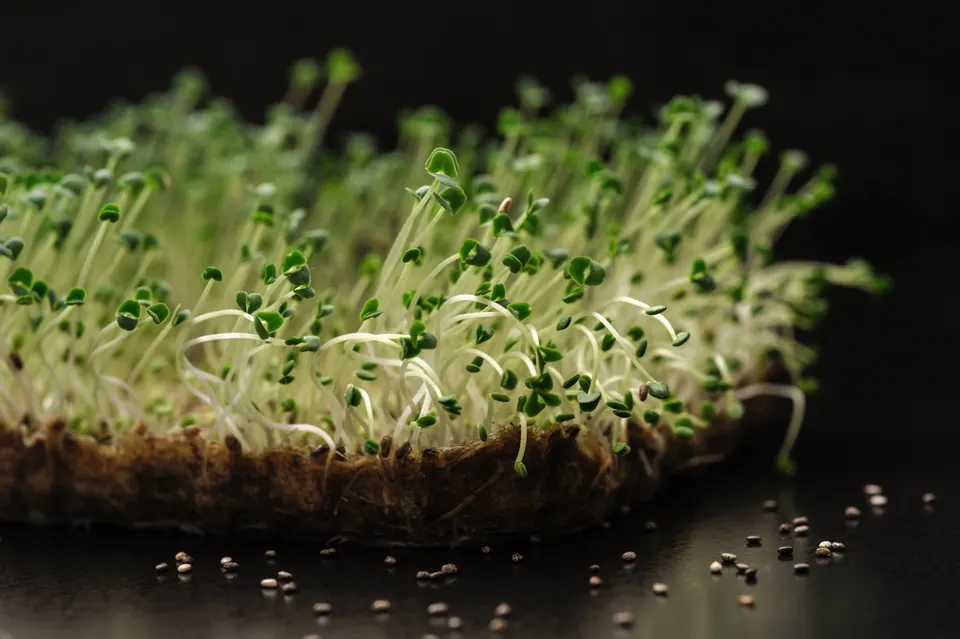
Yes, and this is where the two seeds behave the same. Both are gel seeds: the moment they get wet, they coat themselves in slime. In a sprouting jar they clump into a wet lump that can't drain and goes off quickly.
Grow them flat instead:
- Day0
Set up
Mist a plate, a terracotta saucer or a tray lined with a damp paper towel or grow mat.
- Day0
Sow dry
Sprinkle the dry seed thinly over the surface. Don't soak it first. Mist again.
- Day0–3
Cover
Cover loosely to hold in moisture. Mist twice a day so the seed never dries out.
- Day4–6
Sprouts
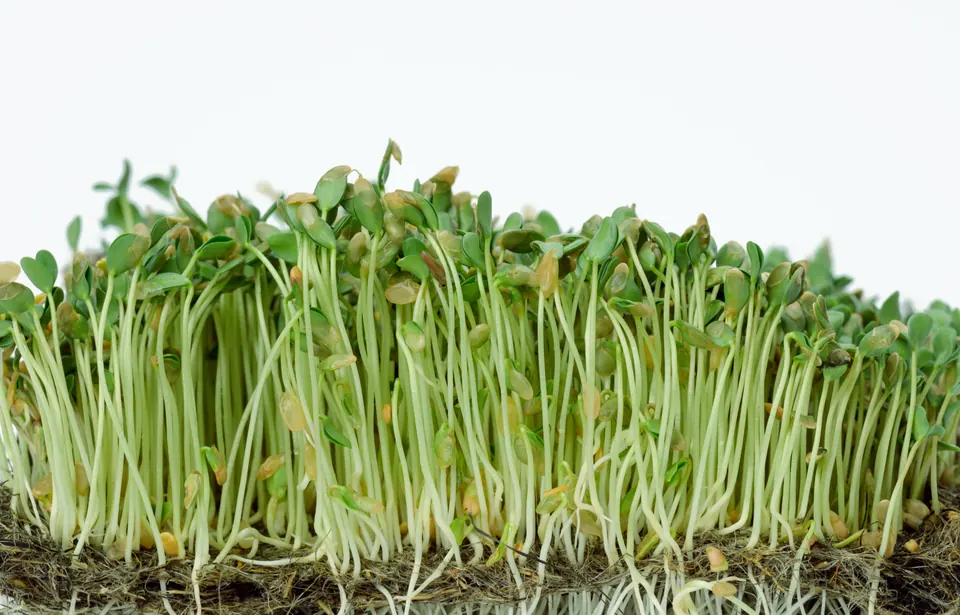
Chia sprouts are ready in 4 to 5 days and flax in 4 to 6. Cut or pull them as small sprouts.
- Day8–12
Microgreens
Or give them light and let them grow on. Cut above the roots at 8 to 12 days.
A 10 × 20 inch tray takes only 15 to 28 g of chia or 15 to 20 g of flax. The seeds are tiny, so a little goes a long way. Chia microgreens taste mild and slightly peppery; flax are mild and nutty. Both are good on salads and sandwiches.
For full guides, see how to sprout chia seeds and how to grow flax sprouts. Sprouting.com sells untreated seed for both: black chia and brown flax. A terracotta sprouting tower works well for gel seeds, because the clay holds moisture without puddling.
Chia seeds vs flax seeds: which should you choose?
Pick by how you'll use them:
- Choose flax if you bake, eat oatmeal most mornings, or want the most omega-3 per spoonful. Grind it and keep it in the fridge.
- Choose chia if you want something you can use straight from the bag, like puddings, jams and drinks, or you want more calcium and fibre.
- Choose both if you can. They do different jobs in the kitchen, and a spoonful of each is an easy way to add fibre and plant omega-3 to your day.
If you like growing your own, both make easy plate-grown sprouts and microgreens. Find more seeds to try in the Seed Library, or start with our step-by-step guide to growing sprouts.
Frequently asked questions
Which is better, chia seeds or flax seeds?
Neither is better overall. Flax has more omega-3 (ALA) and lignans, and it must be ground. Chia has more fibre and calcium, needs no grinding, and thickens liquids. Choose by use: flax for baking and oatmeal, chia for puddings, jams and drinks.
Which has more omega-3, chia or flax?
Flax. An ounce of flaxseed has about 6.4 g of ALA omega-3 and an ounce of chia has about 5 g, according to USDA data. One tablespoon of flax is enough to meet the daily ALA target for adults.
Do flax seeds need to be ground?
Yes, for the most benefit. Whole flaxseed can pass through the gut without being digested. Grind it in a coffee or spice grinder, or buy it ground, and keep ground flax in a sealed jar in the fridge.
Can you eat chia seeds and flax seeds together?
Yes. They go well together in oatmeal, smoothies and baking. Start with a tablespoon of each a day, drink plenty of water, and build up slowly so the extra fibre doesn't cause bloating.
Which is better for digestion, chia or flax?
Both add fibre that can help with regularity. Chia has a little more fibre per ounce. Either one can cause bloating if you add a lot at once, so start small and drink water. Always soak chia before eating it.
Is chia or flax better for weight loss?
Neither is a weight-loss food. Both are high in calories from healthy fats. A U.S. NIH review found that flaxseed lignan extract and flaxseed oil supplements don't seem to help with weight loss. Their fibre can help you feel full as part of a balanced diet.
Can you sprout chia and flax seeds?
Yes, but not in a jar. Both seeds form a gel when wet and clump into a wet mass. Sprinkle the dry seed on a damp plate, terracotta dish or tray, mist it twice a day, and harvest sprouts in 4 to 6 days or microgreens in 8 to 12.

Written by Michael
A passionate sprouting professional sharing practical tips for growing sprouts and microgreens at home. More about Michael
Sources
- U.S. Department of Agriculture, Agricultural Research Service. FoodData Central (SR Legacy and Foundation Foods), values per 100 g. Link
- NIH Office of Dietary Supplements. Omega-3 Fatty Acids: Fact Sheet for Consumers. Link
- National Center for Complementary and Integrative Health. Flaxseed and Flaxseed Oil. Updated 2025. Link
- Mayo Clinic Staff. Flaxseed: Is ground better than whole? Mayo Clinic. Link
- Rawl R, et al. Watch It Grow: Esophageal Impaction With Chia Seeds. American College of Gastroenterology Annual Meeting, 2014 (reported by HealthDay). Link