Short answer: to make Ezekiel bread, soak wheat, spelt, barley, millet, lentils and mung beans for about 8 hours, then sprout them for 1 to 2 days, until the tails just show. Dry them at about 115 to 150°F (46 to 65°C) until hard, then mill them into flour. Make a yeast dough with water, honey, oil and salt, let it rise twice, and bake at 375°F (190°C) for 35 to 45 minutes.
What is Ezekiel bread?
Ezekiel bread takes its name from a verse in the Bible. In the King James wording, Ezekiel 4:9 says: "Take thou also unto thee wheat, and barley, and beans, and lentiles, and millet, and fitches, and put them in one vessel, and make thee bread thereof." Fitches are usually read as spelt.
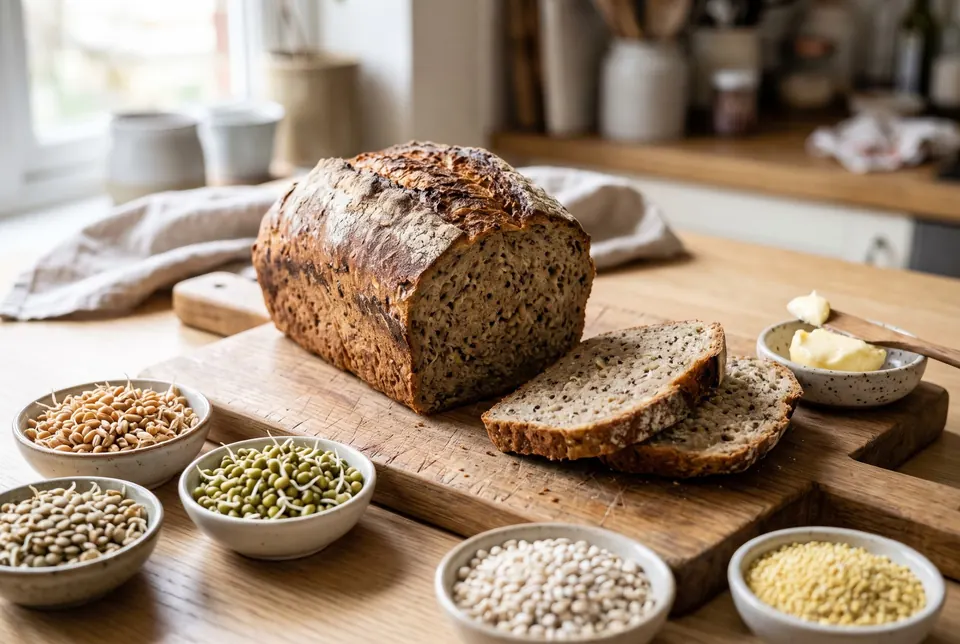
The modern loaf uses those six foods, sprouted. The grains and legumes are soaked until they start to grow, which changes their flavour and how they bake. The best-known shop version is sold frozen. Ezekiel 4:9 is a Food for Life brand; this recipe is our own homemade version and isn't connected with the company.
It's still wheat bread, so it isn't gluten-free. It's denser and nuttier than a sandwich loaf, slightly sweet, and great toasted.
Why we skip kidney beans
Many Ezekiel recipes online add kidney, pinto or great northern beans. We don't, and here's why.
Raw and undercooked kidney beans contain a natural toxin called phytohaemagglutinin. Eating as few as four undercooked kidney beans can cause nausea, stomach pain, vomiting and diarrhea. The toxin is only destroyed at 212°F (100°C) for at least 10 minutes, and gentle, low heating can make raw beans more toxic, not less.1
The centre of a loaf only reaches about 200 to 205°F (93 to 96°C). That's not enough to make raw bean flour safe.
So this recipe uses green lentils and mung beans. Both sprout easily, and lentils and mung beans are the "beans" most people already sprout at home. Adzuki beans work too. If you really want kidney beans, soak and boil them for 30 minutes first, then mash them into the dough.
The six grains and legumes
| Ingredient | Why it's in the mix | Soak range | Ready for bread in |
|---|---|---|---|
| Hard red wheat | The backbone; gives the loaf its rise | 8–12 hours | 1–2 days |
| Spelt | Nutty, sweet flavour | 4–8 hours | 1–2 days |
| Hulless barley | Malty taste and moisture | 6–12 hours | 1–2 days |
| Millet | Mild sweetness | 6–8 hours | 1–2 days |
| Green lentils | Protein and an earthy taste | 6–12 hours | 1–2 days |
| Mung beans | The "beans" from the verse, safely | 6–8 hours | 1–2 days |
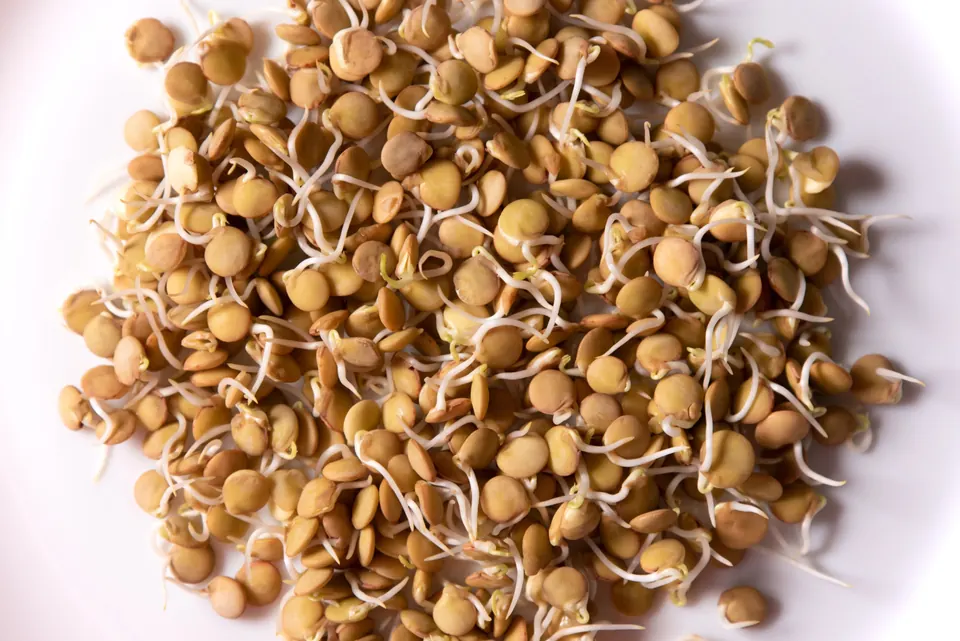
For bread, stop every one of them early, as soon as a tiny root shows. That's sooner than you'd stop them for eating as sprouts. Long sprouts make sticky, gummy bread.
Buying tips: use whole, untreated seed. Pearled barley and polished grocery millet usually won't sprout. Sprouting.com sells hard red spring wheat, spelt, hulless barley, millet, French green lentils and mung beans. The millet comes with its hull on, which sprouts well and grinds in with the rest.
How to make Ezekiel bread, step by step
Plan on 3 to 4 days from dry grain to loaf. You'll only be busy for about an hour in total.
- Day1
Soak
Rinse the grains and legumes. Soak the grains (wheat, spelt, barley, millet) in one bowl and the lentils and mung beans in another, in plenty of cool water, for about 8 hours. That suits all six.
- Day2–3
Sprout
Drain them into two jars or sprouters. Rinse and drain twice a day. Stop each one as soon as a tiny root shows, no longer than ⅛ inch (3 mm). Some will be ready a little before others.
- Day3
Dry
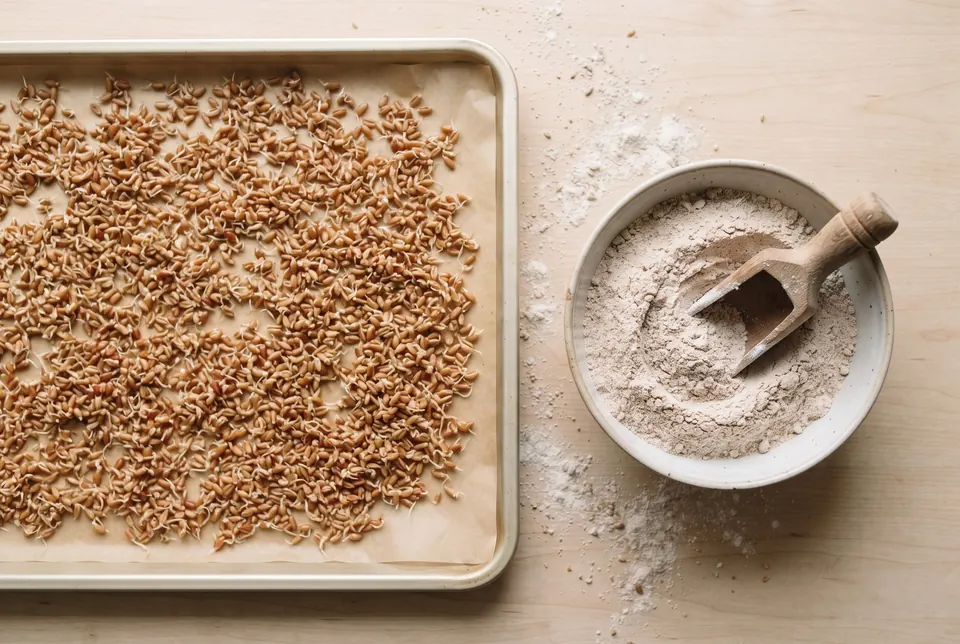
Spread everything thinly on dehydrator trays or baking sheets. Dry at about 115 to 150°F (46 to 65°C) for 12 to 24 hours, until hard and snappy. In an oven, use the lowest setting and prop the door open.
- Day3–4
Mill
Let it cool. Mix it together and mill it in a grain mill on a fine setting, or in a high-power blender in small batches. You'll have about 500 g of Ezekiel flour.
- Day4
Bake
Make the dough and bake it with the recipe card below. Cool the loaf for at least an hour before slicing.
For more detail on sprouting and drying grain, see how to make sprouted wheat flour. You can make a bigger batch of Ezekiel flour and keep it in the freezer.
Tips for a better loaf
- Weigh the grain dry. Measure before you soak. After sprouting and drying, it weighs about the same.
- Use the wheat gluten. Lentil, mung and millet flour don't form gluten, and sprouted flour is weaker than regular flour. Two tablespoons of gluten makes a lighter, higher loaf. Skip it for a denser, more traditional bread.
- Watch the dough, not the clock. Sprouted flour wakes up the yeast fast. If the dough rises over the top of the pan before baking, it can sink in the oven.
- Bake it fully. Sprouted loaves are moist. Use a thermometer and look for 200 to 205°F (93 to 96°C) in the centre.
- Slice it cold, toast it warm. It cuts best the next day. It makes great toast with butter, nut butter or avocado and sprouts.
How to make Ezekiel bread without yeast
If you want a loaf closer to the dense, flourless shop bread, skip drying and milling:
- Sprout the same mix as above, then drain it very well and pat it dry on a towel.
- Grind it in a food processor for 3 to 5 minutes, scraping down often, until it forms a sticky ball. Add 1 teaspoon of salt.
- Form it into a small flat loaf on a lined baking sheet, or press it into a small greased loaf pan.
- Bake at about 300°F (150°C) for 1½ to 2 hours, until firm and lightly browned. Cool completely before slicing.
It's chewy, moist and slightly sweet, and best sliced thin and toasted. Our sprouted bread guide has more on this flourless method.
How to store homemade Ezekiel bread
Homemade sprouted bread has no preservatives, so it doesn't keep long on the counter. Keep it in a bread bag for 2 to 3 days, in the fridge for about a week, or slice and freeze it for up to 3 months. Toast slices straight from the freezer.
Keep spare Ezekiel flour in an airtight container in the fridge or freezer. Like all whole-grain flour, it contains oils that go stale at room temperature.
How to Make Ezekiel Bread at Home
Vegetarian · Home baking
Ingredients
Ezekiel flour (weigh the grain dry, before sprouting)
- 250 g (about 1⅓ cups) hard red wheat berries
- 100 g (about ⅔ cup) spelt berries
- 50 g (about ¼ cup) hulless barley
- 30 g (about 2½ tbsp) whole millet
- 40 g (about 3½ tbsp) green lentils
- 30 g (about 2½ tbsp) mung beans
Dough
- All of the Ezekiel flour above (about 500 g)
- 15 g (2 tbsp) vital wheat gluten (optional, for a lighter loaf)
- 360–390 ml (1½–1⅔ cups) lukewarm water
- 7 g (2¼ tsp) instant yeast
- 10 g (1¾ tsp) fine salt
- 25 g (1 heaped tbsp) honey or maple syrup
- 25 g (2 tbsp) olive oil
Method
- Sprout and dry the grains and legumes as described below, then mill them together into flour. Let warm flour cool before baking.
- Mix the Ezekiel flour, wheat gluten (if using), yeast and salt in a large bowl. Add the honey, oil and 360 ml of the water and stir into a soft, sticky dough. Add more water a spoonful at a time only if it feels stiff.
- Knead for 8 to 10 minutes by hand, or 5 to 6 minutes in a mixer, until it holds together and feels tacky but not wet. It won't get as smooth as white bread dough.
- Cover and let it rise in a warm place until about 1½ times its size. Sprouted flour ferments fast, so check after 45 minutes. It may take up to 1½ hours.
- Roll it into a log and put it in a greased 9 × 5 inch (23 × 13 cm) loaf pan. Cover and let it rise until the top is level with the rim, usually 30 to 60 minutes.
- Bake at 375°F (190°C) for 35 to 45 minutes, until deep brown and hollow-sounding underneath, or 200 to 205°F (93 to 96°C) in the centre.
- Turn it out and cool on a rack for at least 1 hour before slicing.
Notes
- No grain mill? A high-power blender can grind small batches into a coarse flour. Sift out the biggest bits and use them in porridge.
- Short of time? Use 400 g of shop-bought sprouted wheat flour, 50 g of sprouted spelt flour and 50 g of lentil or chickpea flour. It won't be fully sprouted, but it bakes the same way.
- Keeps: 2 to 3 days at room temperature, 1 week in the fridge, or 3 months frozen, sliced.
Frequently asked questions
What is in Ezekiel bread?
Ezekiel bread is based on Ezekiel 4:9, which lists wheat, barley, beans, lentils, millet and spelt. Shop-bought versions use sprouted forms of these grains and legumes. Our homemade version uses wheat, spelt, barley, millet, green lentils and mung beans.
How do you make Ezekiel bread at home?
Soak and sprout wheat, spelt, barley, millet, lentils and mung beans for 1 to 2 days, until tiny tails show. Dry them at a low heat until hard, mill them into flour, then make a yeast dough, let it rise twice and bake it at 375°F (190°C).
Can I use kidney beans in Ezekiel bread?
It's safer not to. Raw and undercooked kidney beans contain a toxin that's only destroyed by boiling. The centre of a loaf never gets that hot. Use lentils and mung or adzuki beans, or boil kidney beans for 30 minutes first and add them mashed.
Is Ezekiel bread gluten-free?
No. Wheat, spelt and barley all contain gluten. Sprouting doesn't remove it. People with celiac disease should avoid Ezekiel bread.
Can you make Ezekiel bread without yeast?
Yes. Skip drying and milling. Grind the freshly sprouted mix in a food processor into a sticky dough, form it into a loaf, and bake it low and slow at about 300°F (150°C) for 1½ to 2 hours. The loaf is dense and moist.
Is sourdough or Ezekiel bread better?
They're different, not better or worse. Sourdough is about the fermentation and usually uses unsprouted flour. Ezekiel bread is about sprouted whole grains and legumes. You can combine them by using a sourdough starter instead of yeast with this flour.
Why is homemade Ezekiel bread dense?
Sprouted flour and lentil and bean flour make weaker dough than white flour, and the whole grain bran cuts through it. Add the wheat gluten, don't sprout the grain too long, and let the dough rise until it's level with the pan, not over the top.

Written by Michael
A passionate sprouting professional sharing practical tips for growing sprouts and microgreens at home. More about Michael
Sources
- Peterson L. Kidney Beans and Slow Cookers. University of Illinois Extension, 2024. Link