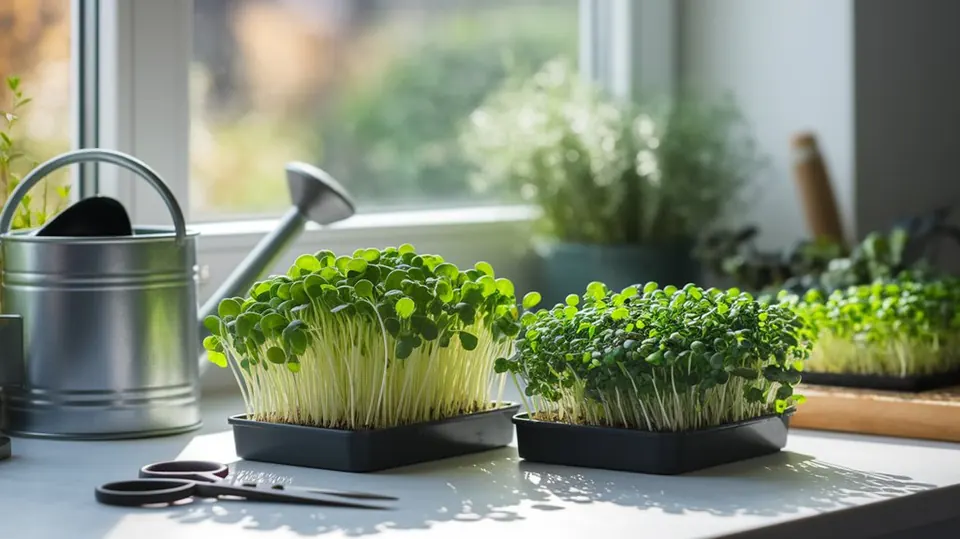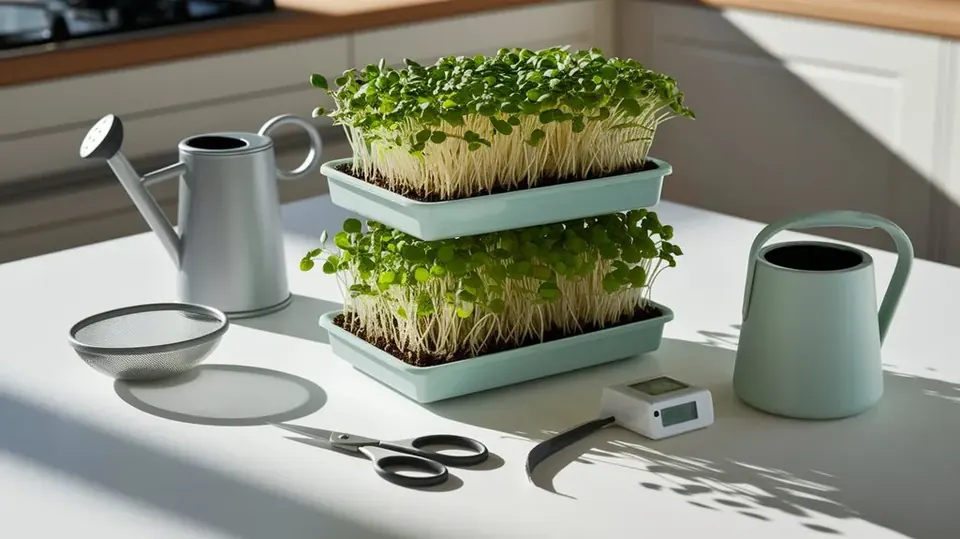
Short answer: use two trays per crop: a shallow tray with drainage holes to grow in, inside a tray without holes to hold water. Pick 1020 (10 × 20 inch) trays for big harvests and big seeds, or 1010 (10 × 10 inch) trays for small, regular batches at home. Choose sturdy trays you can wash and reuse.
The basic setup: two trays
Most microgreens grow best with a simple two-tray system:
- Growing tray, with holes. Holds the soil or mat and the seed. Holes let extra water drain out and let roots drink from below.
- Water tray, no holes. Sits underneath, catches drips, and holds water when you water from below.
A third tray, or a flat board, is handy as a cover during the dark "blackout" days. For big seeds like peas and sunflower, a light weight on top helps the roots grip.
1010 vs 1020 microgreen trays
| 1010 tray | 1020 tray | |
|---|---|---|
| Size | About 10 × 10 in (25 × 25 cm) | About 10 × 20 in (25 × 50 cm) |
| Seed per tray | Roughly half of the 1020 rate | The standard rate in seed charts |
| Harvest | A few days of greens for 1–2 people | A big harvest, or for sharing or selling |
| Best for | Small spaces, trying new crops, a steady supply | Peas, sunflower, wheatgrass, regular growers |
Seed charts usually give amounts for a 1020 tray, so for a 1010, roughly halve them. See the microgreens seeding chart.
Holes or no holes?
| Tray | Use it for |
|---|---|
| With holes | The growing tray, for soil, coco coir or mats |
| No holes | The water tray underneath; also for hydroponic growing on mats with a thin layer of water |
| Mesh-bottom | Some soil-free and hydroponic setups |
Watering from below through holed trays keeps the leaves dry, which helps prevent mold. You pour water into the solid tray, let the roots drink for 10 to 15 minutes, then tip out the rest.
Microgreen trays: what depth?
Microgreens need only about 1 inch (2.5 cm) of growing medium. Shallow trays, around 1 to 2½ inches tall, are best:
- They use less soil.
- Light reaches the whole tray evenly.
- It's easier to cut close to the soil.
Taller trays are fine for wheatgrass and big seeds, but they're not needed.
What to look for in microgreen trays
- Sturdiness. Thin trays bend and crack. Heavier trays last for many crops.
- Food-safe material, with no strong chemical smell.
- Even holes across the bottom of the growing tray.
- Trays that nest together, so the growing tray sits snugly in the water tray.
- Matching sizes, so covers and weights fit.
Microgreen trays for different growing methods
| Method | Trays |
|---|---|
| Soil or coco coir | Holed growing tray + solid water tray |
| Hemp or jute mats | Holed or solid tray, depending on how you water |
| Hydroponic (water only) | Solid tray, or a mesh tray over a reservoir |
| Sunflower without soil | Holed tray inside a solid tray with about ¼ inch of water |
For soil-free options, see how to grow microgreens without soil. For soil and mats, see best growing medium for microgreens.
Do you need special trays?
Not to start. A shallow food container with holes poked in the bottom, set in a plate or lid, works for a first trial. Takeout containers and old baking pans work too. Proper microgreen trays are worth buying once you grow regularly, because they're the right height, drain evenly and stack neatly.
Where to buy microgreen trays
We link to trays from Sprouting.com:
- 1020 trays, 2-piece set (holed tray plus solid tray)
- 1020 tray, no holes
- 1010 trays, 2-piece set
- 1010 tray, no holes
- Baby Blanket grow mats sized for trays
We earn a commission if you buy through these links, at no extra cost to you.
Caring for your trays
- Wash trays in hot, soapy water after every crop and rinse them well.
- Scrub out old roots and soil from the holes.
- Let them dry fully before stacking.
- Replace cracked trays, which can harbour mold and leak.
Next: follow the step-by-step microgreens guide to grow your first tray.
Frequently asked questions
What size tray is best for microgreens?
For most homes, a 10 × 10 inch (1010) tray is a good size: enough microgreens for a few days for one or two people. Use 10 × 20 inch (1020) trays if you eat a lot, grow big crops like peas and sunflower, or sell what you grow.
Do microgreen trays need holes?
The tray you grow in should have holes, so excess water drains away and you can water from below. Set it inside a tray without holes to catch the water. You need both.
What's the difference between a 1010 and a 1020 tray?
A 1020 tray is about 10 × 20 inches, the standard size in seed charts. A 1010 tray is half that, about 10 × 10 inches. Seed amounts for a 1010 are roughly half of the 1020 rate.
How tall should microgreen trays be?
Shallow trays about 1 to 2½ inches (2.5 to 6 cm) tall work best. You only need about 1 inch of growing medium, and shallow trays make cutting easier.
Can I reuse microgreen trays?
Yes. Sturdy trays last for many crops. Wash them in hot, soapy water between batches and rinse well. Thin, flimsy trays crack quickly, so heavier trays are worth the extra cost if you grow often.

Written by Michael
A passionate sprouting professional sharing practical tips for growing sprouts and microgreens at home. More about Michael